




Promotional Gift ROI Calculation Example: Measure Campaign Impact
The number of promotional gifts handed out does not yet show whether a campaign paid off. A promotional gift ROI calculation example helps you link the costs of the gifts, marking, design and delivery to measured enquiries or sales – rather than to the assumption that every item handed out produced a result.
The impact of a campaign can be difficult to assess, because the costs are spread across several lines and the recipient may not make an enquiry or purchase straight away. That is why you should separate actual data from assumptions in the calculation and attribute only a justifiable share of the result to the campaign. In this guide you will find a formula you can copy and a table you can fill in and adapt to your own campaign data.
Let us look step by step at how to calculate the total cost, choose a measurable result and assess the return. With the example you can compare product, quantity and marking options and determine what data you need to make a decision. Logotrade has been helping companies choose promotional gifts, marking methods and design solutions since 2004.
- Use the promotional gift ROI calculation example to compare the additional revenue attributed to the campaign with its total cost.
- Distinguish the ROI percentage from other return measures and choose the metric according to the campaign goal.
- Compare products by suitability for the target group, marking method and confirmed quote – not by assumed prices.
- Before the campaign, define the measurement period, tracking method and the person responsible for collecting data.
- To prepare an enquiry, write down the campaign goal, target group, quantity, budget range and date of use.
What does a promotional gift ROI calculation show and when should you use it?
A promotional gift ROI calculation shows the ratio of the additional revenue attributed to the campaign to the campaign's total cost. To get it, the total cost is subtracted from the additional revenue and the result is divided by the total cost. With the example you can assess whether the chosen gift supported the goal – for instance making contact, arranging a meeting, winning an order or developing a client relationship. It also helps you separate measured results from assumptions.
An ROI calculation requires the campaign goal, the costs to be included, the measurement period and the way of assessing the result linked to the gift to be agreed before the campaign.
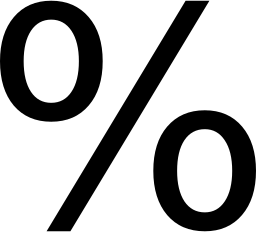
In general, the return describes whether the campaign result justifies the cost incurred. The ROI percentage shows the ratio of the net result to the campaign's total cost. It is one way of measuring return on investment, not the same as additional revenue or the number of orders won. With promotional gifts, the meaning of the calculation depends on which result and which costs you take into account.
When does it make sense to calculate the ROI of promotional gifts?
The calculation is most useful for a specific campaign where the target group and the expected follow-up action are known. The goal might be a contact made at an event, a quote following a client meeting or registered participation in a campaign aimed at employees. Before the campaign, decide which result counts as a success and how long you will track it.
Visibility alone does not prove sales revenue or a return. A gift may be noticed or used, but without trackable follow-up you cannot conclude that it led to an enquiry or purchase.
Which results can be linked to a gift?
Keep the results separate: the number of items handed out shows distribution, responses and contacts show interest, meetings show follow-up and orders show sales. Choose a practical tracking method, such as a campaign code, a separate landing page or a note in your CRM system, and record all results under the same campaign.
These methods show a connection, but they do not always prove that the gift caused the result. Take other possible influences into account and attribute only a justifiable share of the result to the campaign. This allows you to compare campaigns more honestly, without the number of items handed out replacing measured impact.
Promotional gift ROI calculation example: formula and template
The basis of the calculation is simple, but the result depends on which revenue you attribute to the campaign and which costs you add up. Enter the company's confirmed data into the formula – not forecast sales or the number of gifts handed out. The example below helps you bring the inputs, sources and uncertainty together in one place.
ROI % = (attributed additional revenue − total campaign cost) ÷ total campaign cost × 100%.
A positive result means that the attributed additional revenue exceeded the total cost entered in the formula; a negative result shows the opposite. The model does not prove that the gift itself caused the sale. Use revenue that you can justifiably link to the campaign and document the basis for the attribution.
Total campaign cost: which lines to include?
Bring together all campaign-related costs confirmed in documents. Depending on the campaign, these may include:
- the cost and quantity of the promotional gift products;
- design and marking;
- packaging and delivery;
- costs of organising the campaign, if they are included in the accounts and can be documented.
Do not add assumed amounts, and do not treat taxes the same way in every situation. For companies registered in Estonia, a promotional gift with a logo to a client or partner is exempt from income tax up to 21 € excluding VAT; above that, the entire value is taxed at 22/78. A separate 10 € threshold excluding VAT applies to VAT, and gifts to employees are generally fringe benefits. Base the tax treatment on the company's verified accounting data and check the current guidance of the Estonian Tax and Customs Board (in Estonian). The cost of the product, marking and other components must come from a confirmed quote or an accounting document.
ROI calculation template you can copy
Fill in each row with your campaign data. The "confidence level" helps distinguish documented input from estimated attribution, but it does not replace the source.
| Input | Value | Source | Measurement period | Confidence level |
|---|---|---|---|---|
| Unit quantity | [actual quantity] | [order/invoice] | [campaign period] | [high/medium/low] |
| Unit cost | [confirmed amount €] | [quote/invoice] | [cost date] | [high/medium/low] |
| Additional costs | [confirmed amount €] | [invoices/accounting] | [cost dates] | [high/medium/low] |
| Total campaign cost | unit cost × quantity + additional costs | [calculated from the sources above] | [campaign period] | [assess based on inputs] |
| Measured responses and contacts | [actual number] | [campaign report/CRM] | [start and end] | [high/medium/low] |
| Attributed additional revenue | [confirmed amount €] | [CRM/sales data] | [start and end] | [assess based on attribution basis] |
| ROI % | (attributed additional revenue − total cost) ÷ total cost × 100% | [calculation] | [same period] | [depends on the reliability of inputs] |
Use the same measurement period for comparable figures and clearly mark any estimated revenue. Enter prices and production data into the calculation only on the basis of a confirmed quote.
How to compare promotional gift options without overestimating the return
Compare options on the basis of the same campaign goal and target group. A lower unit cost does not automatically mean a better result. The gift must suit the situation in which it is used, and it must be possible to track whether the recipient took action. Do not assume that any product category guarantees a higher return than others.
Compare product suitability, not just unit cost
For each option, ask who the gift is for, where it will be used and what follow-up you expect. For example, a pen or other writing instrument may suit handing out at a meeting, while a drinking bottle suits a situation where the recipient can use it every day. These are questions of choice, not promises about use or sales results.
Consider the quantity, actual use and whether the logo remains visible during use. A promotional gift ROI calculation example is only useful if you compare options on the basis of the same input data.
Marking and design affect measurability
When choosing a marking method, start from the product's material, the design and the quantity – for example, laser engraving suits metal and wood. Ask for the marking option and production time separately in the quote, as they cannot be assessed on assumptions. Our advertising design service helps prepare the artwork.
Give each option being compared a distinct campaign code or response channel. This lets you see which choice the contacts or enquiries were linked to, without overestimating causal impact.
"The number of items handed out shows distribution, not the campaign result."
Use the comparison framework below. Fill in the cost and production time on the basis of the confirmed quote and add the usage situation that links the product to the campaign goal.
| Product category | Quantity | Confirmed quote cost | Marking method | Production time | Usage situation | Measurable follow-up |
|---|---|---|---|---|---|---|
| Writing instruments | [enter quantity] | [quote amount €] | [confirmed method] | [as per quote] | [e.g. meeting or event] | [code, response channel or CRM note] |
| Drinking bottles | [enter quantity] | [quote amount €] | [confirmed method] | [as per quote] | [define the target group's usage situation] | [define tracking method] |
| Textiles | [enter quantity] | [quote amount €] | [confirmed method] | [as per quote] | [define the campaign's usage situation] | [define tracking method] |
Then check whether each option suits the target group, whether the costs and production time are confirmed in the quote and whether there is a clear way of tracking results. If a condition is not met, mark it as open in the comparison rather than treating an assumption as a measured result.
How to measure the campaign result and calculate the return step by step
Reliable evaluation starts before the gifts are handed out. Write down the campaign goal, metrics and tracking method, and set the measurement period and the person responsible for data collection. That way it will be clear later where an enquiry came from and which costs went into the calculation.
- Define the goal. Set the main target, such as the number of contacts, meetings or orders, and decide which action counts towards the result.
- Describe the baseline. If earlier data is available, collect it for a comparable period and target group. Baseline data for the same metric helps put the result in context.
- Choose a tracking method. Use a campaign code, a separate response channel or a note in your CRM system, and agree how campaign-related contacts and sales will be recorded.
- Set the period and the person responsible. Fix the start and end of measurement before the campaign. The designated employee records the results in the agreed way.
- Bring costs and results together. Use confirmed cost documents and campaign and sales data, and calculate the return after the period ends, once the inputs have been checked.
Campaign metrics and data sources
Keep the figures separate: the number of items handed out, enquiries, meetings, orders and attributed revenue. Use the company's existing campaign data or CRM system and note any data limitations – for example, a contact may be recorded but the order never placed, or the campaign code may be missing from the sales data.
Comparing with an earlier campaign or a suitable control group can provide extra context if the data is comparable. Keep the target group, period and metric on the same basis. Results of campaigns with different goals or tracking methods may not be directly comparable.
Common mistakes that make the calculation misleading
Do not attribute all sales in the campaign period to the gift if there is no reliable link. Do not leave campaign-related design, marking, packaging or delivery out of the total cost. Brand awareness may be a campaign goal, but do not present it as monetary revenue if there is no justified method for assessing it.
Present measured sales and estimated long-term brand impact separately, and do not combine them into a single revenue figure. If you want to link results to a suitable promotional gift and marking solution, send an enquiry with the campaign goal and required quantity and compare options on the basis of confirmed quotes.
How to turn the calculation into a Logotrade promotional gift enquiry
Turn the spreadsheet into the brief for your enquiry: note the confirmed data, initial assumptions and the questions you need the quote to answer. This makes it possible to assess the product selection, design and marking together with the campaign goal. Once you have the quote, you can enter the actual costs into the calculation.
What information do you need for a personal selection?
Include the information that affects the choice and comparison in your enquiry:
- Goal and recipients: describe what you want to achieve with the campaign and who the gift is for.
- Quantity and budget range: state the planned quantity and the campaign's budget limits.
- Usage situation: explain where or when the gifts will be used and by what date you need them.
- Design materials: attach the logo file and describe whether you have a specific design request or marking method in mind.
- Delivery information: state the delivery location and schedule so that the assumptions of the quote are clear.
If the product has not yet been decided, start with our range of promotional products with a logo. Choose a few suitable options and request comparable data for them. The price and production time confirmed in the quote replace the initial estimates in the spreadsheet.
How to link the enquiry to real results and a reliable example
Compare suppliers' quotes on the basis of the same quantity, marking, design and delivery assumptions. Check whether the price includes all campaign-related cost lines, and note in the model which quote relates to which option. That way you can later compare the forecast cost with the actual invoice.
If you use an example from our portfolio to justify a choice, make sure it matches the planned product or marking. Do not infer your own campaign result from the example. Present a client result or specific case only if the data is confirmed and you have permission to use it.
Make your next campaign measurable
A promotional gift ROI calculation example provides a framework that you can adapt to the campaign goal and confirmed data. Use the calculation to make decisions, not to predict the result in advance. If an input is based on an estimate, mark it clearly and, where possible, check it after the campaign.
Before confirming your choice, make sure that the product, design and marking suit the planned usage situation and that the quote data is comparable. Use portfolio examples for inspiration, not as proof of your own campaign result, unless the case data has been confirmed.
Frequently asked questions
How do you calculate the ROI of promotional gifts?
Subtract the total campaign cost from the additional revenue attributed to the campaign, divide the result by the total cost and multiply by one hundred. The formula is: ROI % = (attributed additional revenue − total campaign cost) ÷ total campaign cost × 100%. Include all relevant campaign costs in the total and use the company's verified sales and cost data. Also note the measurement period and the basis for linking revenue to the campaign. The number of gifts handed out shows distribution, not revenue earned.
Which costs should be included in a promotional gift ROI calculation?
Include the costs of products, design, marking, packaging, delivery and campaign organisation if they were part of the specific campaign. Use actual quotes, invoices and accounting data, not assumed prices. Note the source of each cost in the spreadsheet so that you can check the inputs later. Confirm the tax and VAT treatment with your accountant and the current guidance of the Estonian Tax and Customs Board.
Can the return of a promotional gift campaign be measured without sales?
Yes, you can also assess intermediate results such as trackable enquiries, meetings or registrations. These metrics help you see whether the campaign led people to take the desired action, but they are not automatically sales revenue and do not prove a return on investment. Record them separately as performance indicators, define the tracking method and measurement period, and do not assign them a monetary value without a reliable basis.
How do you separate the effect of a promotional gift from ordinary sales?
Choose a tracking method before the campaign, such as a campaign code, a separate response channel or a note in your CRM system. Compare the results with a suitable baseline period if comparable data is available, and check whether a contact or order is actually linked to the campaign in the tracking data. Coincidence in time does not in itself prove a causal effect, so mark the measured and estimated parts separately in the calculation.
Is the return on promotional gifts always positive?
No. The result can be positive, zero or negative, and it depends on the measurement period, the total cost and the result taken into account. A negative result does not necessarily mean the campaign had no other value, but visibility cannot be presented as proven revenue. Check whether the goal and tracking method were appropriate and whether all costs were included, and base decisions on the next campaign on documented data, not assumptions.
How does the taxation of gifts affect the ROI calculation?
Tax treatment can change the total cost of a campaign, so check it with your accountant before calculating and review the guidance of the Estonian Tax and Customs Board in force at the time. Under Estonian rules, a gift worth more than 21 € excluding VAT is generally taxed on its full value, but the specific treatment depends on the circumstances of the gift. Check the VAT treatment separately and do not generalise about a single gift without checking the facts.
Logotrade is a member of the international promotional products networks PSI and ASI and of the Estonian Chamber of Commerce and Industry.
Once your calculation is ready, ask us for a quote: we deliver promotional gifts in Kuressaare and across Estonia. You will find more practical advice on our blog.