


Custom logo socks: decoration methods, materials and ordering in 2026
Custom socks are one of the few corporate gifts people actually wear. They are less likely to end up in a drawer beside yet another promotional pen. A successful order starts with three decisions: how to add the logo—knitting it into the sock, printing or embroidery—which material to use, and what quantities and lead time the project needs. We work through those choices just as we would in a conversation with a client, then explain how embroidered clothing and pad-printed accessories can turn the socks into a coordinated gift set.
Logo.ee helps you choose suitable promotional products and handles the design, printing or embroidery, packaging and delivery in one place.
Explore branded giftsKey points
- Knitting the logo into the sock gives the most durable result because the design is part of the knit rather than applied to the surface. It suits larger orders when sufficient production time is available.
- Printing (sublimation or DTF) is suitable for photos, colour gradients and fine details. Embroidery is suitable for thicker socks and a small logo on the calf.
- The material determines whether a sock will be worn for years or just once. A higher quality cotton blend is worth it.
- Textiles sold in the EU must have their fiber composition indicated, and the regulation has separate rules for socks.
- Plan your schedule backwards: start with the date of the event or Christmas and leave some space for design approval, production, and delivery.
Contents
- Why choose socks?
- Four ways to add your logo to socks
- Materials and labelling: what to check
- Designing a logo that works on socks
- Quantities, sizes and lead times
- Embroidered logos on clothing and workwear
- Pad printing for the other items in your gift set
- Our approach: small gifts deserve careful planning
- Custom socks and a complete gift set from one supplier
- Frequently asked questions
- Sources
Why choose socks?
Socks are an everyday item. Everyone wears them, the size is easy to choose and the gift does not seem intrusive. Unlike a T-shirt, the recipient does not have to think about whether the logo matches their style, because the sock is usually under the shoe or hidden by the leg of the pants. At the same time, a colleague in the office, a training partner in the locker room and a friend will see it when guests take off their shoes. In Estonia, where people wear socks at home, this is an especially useful place for a brand to be seen.
Logo socks are suitable for many purposes:
- Employee gift: in a Christmas package, anniversary or new employee welcome kit.
- Gift for clients and partners: gift box with mug or notebook.
- Team attire: sports competition, company run, corporate tournament.
- Events and fairs: a colorful sock stands out and is more likely to be accepted than a flyer.
- Charity and community: socks whose sales proceeds go to a specific cause.
The latter is not just a theory. For example, a research paper describes the use of socks as a fundraising tool at a center that provides equine therapy for low-income people. If the sock has a story, such as a team inside joke or a cause it supports, the recipient will wear it more proudly and tell others about it.
Four ways to add your logo to socks
The choice of technique affects the price, minimum quantity, production time and how the sock looks after the tenth wash. The table below summarizes the main differences.
| Method | How the logo is applied | Best suited to | Points to consider |
|---|---|---|---|
| Jacquard knitting | The logo is knitted into the sock using coloured yarns | Larger orders, long-term wear and designs covering the whole sock | Fine details and very small lettering need simplifying; the number of colours is limited |
| Sublimation printing | The dye is transferred to the synthetic fiber with heat. | Photos, colour gradients, full print all over the sock | Requires a material with a high polyester content, the base of the fabric may show through when stretched |
| DTF printing | The design printed on the film is pressed onto the fabric | Small logo on the cuff, smaller quantities | The print is on the surface, in a very flexible place, the placement must be chosen carefully |
| Embroidery | The logo is sewn onto the fabric with threads | Thick winter or lounge socks, small logo above the ankle | The embroidery may look stiff on a thin sock, it is more suitable for a small badge |
Jacquard knitting: a classic, durable option
A knitted-in logo is part of the sock itself. It will not crack, peel or fade faster than the rest of the sock. Jacquard knitting lets you design the whole sock, including the main colour, heel and toe, stripes, pattern and logo. The limits come from the knitted structure: the machine forms a grid of stitches, so curves appear stepped and very fine lettering may become illegible. For that reason, a logo often needs simplifying—for example, by removing a small tagline or shadows.
Sublimation for photographic designs
Sublimation is a good choice for photographs, colour gradients and complex illustrations. The dye bonds with the fibres, so the print cannot be felt on the surface. The sock must, however, contain a high proportion of synthetic fibre; sublimation is unsuitable for cotton socks. When the sock stretches, the lighter fabric underneath can show between parts of the design. It is worth checking a physical sample before placing a large order.
DTF printing and embroidery on ready-made socks
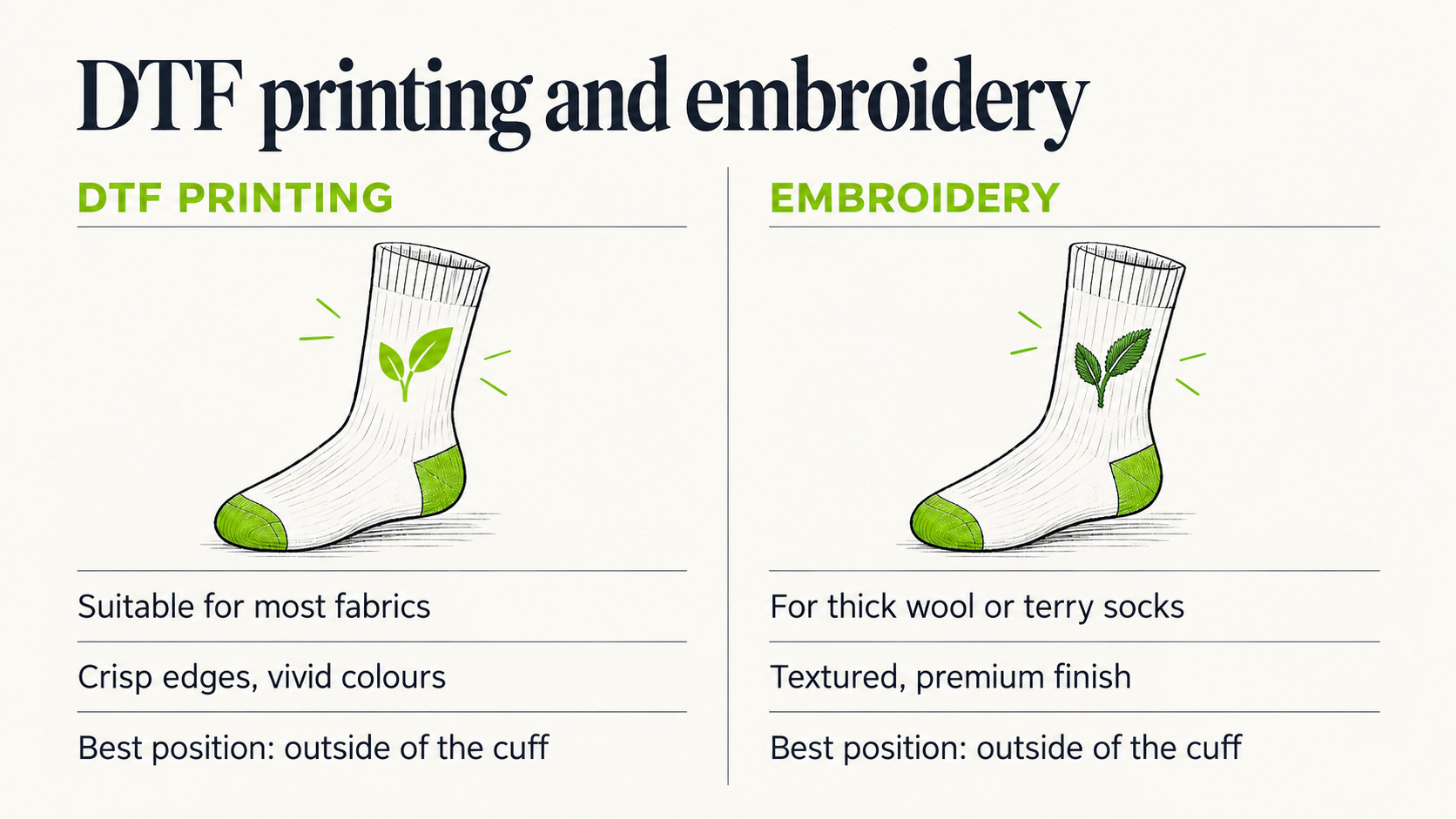
DTF printing or embroidery can suit smaller orders or an existing sock design. DTF printing works on most fabrics and produces crisp edges and bright colours. Embroidery adds texture and a premium finish, particularly on thick wool or terry socks. In both cases, the outer side of the cuff is usually the best position because the fabric stretches least there.
How packaging adds value
What often turns socks into gifts is the packaging: a cardboard sleeve with a logo, a sticker or a gift box. This way, even a simple, solid-colored sock can be branded without adding anything to the sock itself. The same idea applies to labels: a label with a logo sewn into the fabric or attached to a pair of socks is a discreet solution for those who do not want the logo to be visible.
Materials and labelling: what to check
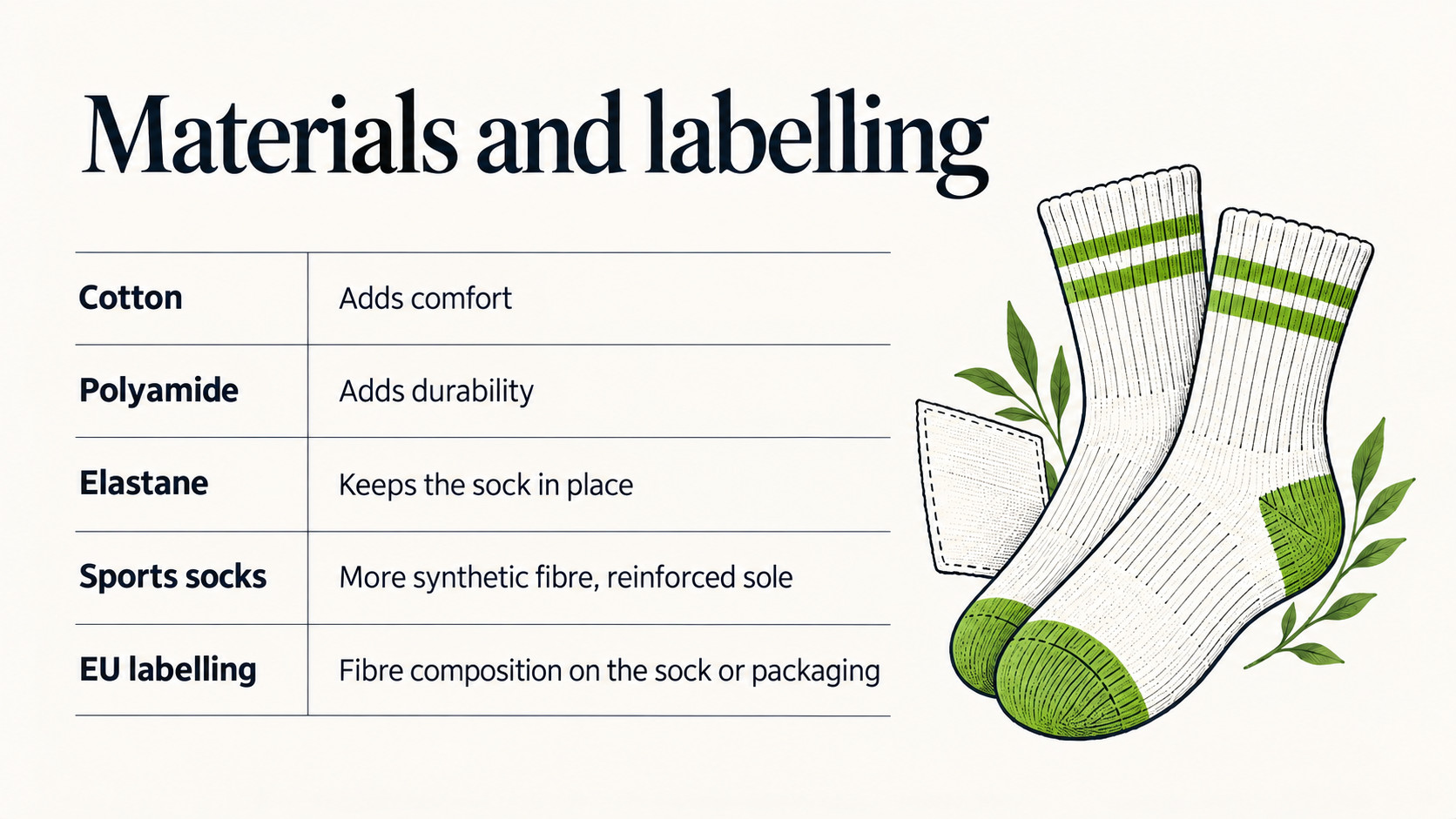
The material of the sock affects whether a person wears it or not. A cheap sock that loses its shape after a few washes does not bring a good reputation to the brand, quite the opposite. A common composition of branded socks is combed cotton with polyamide and elastane: cotton provides comfort, polyamide provides durability, and elastane keeps the sock in place on the foot. Sports socks often have more synthetic fibers and a reinforced sole, winter socks have wool or terry cloth.
When socks are sold or distributed in the European Union, labelling requirements must be taken into account. Regulation (EU) No 1007/2011 lays down the names of textile fibres and the rules for labelling the fibre composition. The European Commission’s Frequently Asked Questions on the Textile Regulation explains that the Regulation covers products at all stages of the supply chain and requires textile products sold in the EU to be labelled with information on the fibre composition. The Regulation has specific rules for socks, for example on how to treat heel and toe reinforcements when determining the composition. In practice, this means that a pair of socks or their packaging should clearly state what the sock is made of.
If you plan to resell socks with the logo, for example in a club fan shop or at a charity sale, ask the manufacturer for information on the fiber composition and labeling solution before ordering. If you have any doubts about whether your use requires labeling, ask the Consumer Protection and Technical Surveillance Authority for clarification.
Designing a logo that works on socks
A sock is a small, flexible surface. A design that looks good on screen may not work as well in the fabric. These principles will help:
- Simplify your logo. Skip the fine lines, shadows, and small text. If your logo has a symbol and a wordmark, often use just the symbol on the sock.
- Limit the number of colors. The number of colors in a knit sock is technically limited. Fewer colors also give a cleaner result.
- Think about contrast. A dark logo on a dark background will disappear. Light threads on a dark sock or vice versa will be readable even from a distance.
- Use a pattern, not just a logo. Stripes in brand colors, a repeating pattern, or a motif that is meaningful to the company (such as a product, mascot, or local symbol) make a sock more wearable than a large logo on the calf.
- Choose the logo location. The logo is visible on the outside of the cuff, the bottom of the sole is a surprise, and the color of the toe and heel provides a detail that sets it apart.
- Ask for a sample before production. A visual shows the idea, but only a physical sample shows how the colors and proportions will actually turn out.
Good sock design doesn't scream. Socks that are stylish even if the recipient doesn't notice the logo are the most worn. Brand awareness comes from colors and details.
Quantities, sizes and lead times
Ordering socks with your logo is a project, not an addition to your shopping cart. Here's how to get there smoothly:
- Determine the purpose and recipients. Are the socks for employees, customers, or event attendees? This will determine the style, material, and packaging.
- Determine quantity and sizes. Gather employee sizes in advance or use common size ranges. One size rarely fits all.
- Choose a technique. For larger orders and lasting wear, choose a knitted-in design. For smaller orders or shorter deadlines, printing or embroidery on ready-made socks may be more suitable.
- Confirm the design. Review the visuals and colors carefully. Changes after production begins are expensive or impossible.
- Sample: For larger orders, a sample is good insurance.
- Production, packaging and delivery. Please note that producing knit socks takes more time than adding a logo to an existing sock.
The most common mistake is starting too late. If the socks need to be in the Christmas package, start preparing in the fall. This way you have time to approve the design, make a sample, and ship without rushing.
Regarding the price: the final price of a sock with a logo depends on the technique, number of colors, material, quantity and packaging. The unit price decreases as the quantity increases, because the setup work is divided over a larger number of pairs. Therefore, it is wise to request a quote for several quantities at once and compare.
Embroidered logos on clothing and workwear
Socks are often part of a larger set: a team gets socks, a polo shirt and a hat, while construction company employees get work clothes with a uniform logo. Here, embroidery is the most common choice.
Embroidery creates a logo with colored threads directly on the fabric. The embossed result is suitable for polo shirts, fleece, jackets, work clothes and hats. Before production, the logo is converted into an embroidery program, where the stitch direction, density and thread colors are determined. The finished embroidery is durable and does not wear out quickly in the wash, making it especially suitable for clothing that is worn every day.
Embroidery on workwear is worth considering through three questions:
- Location: Left chest, sleeve, or back. It is often better to print a larger logo on the back because large embroidery becomes heavy and stiff.
- Material. Embroidery works well on thick fabrics like work pants, softshell jackets, and fleece. On very thin fabrics, the embroidery may pull through the fabric.
- Logo detail. Very small text will not be legible in embroidery. A simplified logo will always be clearer in embroidery.
If a garment requires a large, colorful design, DTF printing, screen printing, or DTG digital printing is a better option than embroidery. In many cases, a combination of a small embroidered logo on the chest and a print on the back is used.
Pad printing for the other items in your gift set
If you want to add something hard to the gift box, such as a pen, a drink bottle or a key chain, pad printing comes into play. This technique uses a silicone pad to apply the color to the product and is also suitable for curved and uneven surfaces. Therefore, pad printing is used on writing instruments and smaller plastic products, for example. Laser engraving is often a better choice for wooden and metal products, while UV printing is a better choice for full-color designs.
For example, a wooden ballpoint pen Arica, a recycled notebook Mendel, or a gift set of ceramic mugs for a winter gift would go well with a gift box with socks. The combination of warm socks and hot tea is always welcome in the Estonian winter.
Our approach: small gifts deserve careful planning
We have been dealing with promotional gifts since 2004 and have seen that textile gifts can be especially appreciated, but they are also easy to get wrong. Socks are no exception. The most common request we hear is “big logo, bright colors”, but the most worn socks are those where the brand is hidden in the pattern, colors or small details. We always recommend starting with the question: would you wear this sock on your day off?
Secondly, we see that the timeline is as important as the design. For us, a project-based approach means that we set a date with the client when the socks need to be delivered and plan all the steps backwards from there. This way, we can choose the technique that fits the deadline, not the other way around.
Third: Think about the package. A sock on its own is nice, but thoughtfully packaged with another useful item says much more about your company’s care. That’s why we prefer to look at the gift as a whole, from the product and design to the packaging and delivery.
Custom socks and a complete gift set from one supplier
Logo.ee helps you choose the right technique for your socks, prepares the artwork, and takes care of decoration, packaging and delivery in Estonia and across Europe. We do DTF, silk-screen, pad, and UV printing, laser engraving, and embroidery, so that socks, clothing, and other items in your gift box have the same consistent look. Check out our decoration services, browse promotional product categories, and see our promotional gift selection. Send us a request on the Logo.ee page, and we'll put together a solution that's right for your project.
Frequently asked questions
Should the logo be knitted into the socks or printed?
A knitted-in logo is more durable and suits larger orders with enough lead time. Printing is better for photographs, colour gradients and smaller quantities. If you are unsure, request samples of both and compare them after a few washes.
How long does it take to make custom socks?
Lead time depends on the method, quantity and how quickly the design is approved. Knitting custom socks takes longer than printing or embroidering ready-made socks. Start at least several weeks before your deadline; for Christmas gifts, begin planning in autumn.
Can a logo be embroidered on socks?
Yes, especially for thick wool, terry or winter socks. Embroidery is suitable for a small logo on the cuff, where the fabric stretches the least. For thin sports socks, it is better to choose a knit or print.
Which materials work best for corporate socks?
A common and comfortable choice is a cotton blend, with polyamide for added durability and elastane to keep the sock in place. Socks containing more synthetic fibres are suitable for sports, and wool for winter. If socks are sold in the EU, the fibre composition must be labelled.
Do custom socks make good gifts for clients?
They are suitable, especially in a gift box with another useful item, such as a mug or a notebook. Choose a stylish design and high-quality material so that the sock will remain in use. This way, the gift will be a reminder of your company every time the socks are put on.