


Branded tote bags: choosing the material, printing method and quantity
A good branded tote bag is one the recipient still takes shopping, to the gym or to work years after a trade fair or company Christmas party. Three things need to work together: fabric that carries the load without stretching, branding that withstands washing and abrasion, and a design people are happy to carry. This guide covers the reusable bags available to businesses, how to choose the right size and handles, which printing methods suit each fabric, what to check before placing a larger order, and when a bag makes a useful promotional gift.
In short
- The material determines the lifespan. Thicker cotton, canvas, and jute will last for years, while thin non-woven is more suitable for a one-time event.
- Printing depends on the design and quantity. A one- or two-color logo for a large quantity is classically a screen printing job, a multi-color or photo design for a smaller quantity is suitable for DTF or DTG printing, and a discreet, premium logo is suitable for embroidery.
- The environmental benefit comes from use. A cotton bag only pays for its climate impact compared to a plastic bag after dozens of uses, so the greenest bag is the one that is actually used.
- Check the fabric and color, print area, minimum quantity, sample, and delivery time before ordering , especially if the bags need to be ready for a specific event.
- A bag works as a gift if it is practical in the recipient's life: large enough, with strong handles and a modest, tasteful design.
Table of contents
- What cloth and reusable bags are available?
- Size, handles and color according to purpose
- Printing and branding methods for tote bags
- How green is a reusable bag really?
- What to check before ordering a large quantity
- When is a bag with a logo a good promotional gift?
- Our view: choose a bag people will keep using
- Order your branded bags from one supplier
- Frequently asked questions
- Sources
What cloth and reusable bags are available?
In everyday language, a "cloth bag" usually means a cotton carrier bag, but the company's range of promotional bags is much wider. Each material is suitable for different purposes and budgets.
Cotton tote bags are the most popular choice. Fabric is sold by fabric weight: the higher the weight per square meter, the denser and more durable the bag. Thinner cotton is lightweight and affordable, suitable for gift wrapping at an event or for sharing at a trade show. Thicker cotton holds its shape, carries heavier groceries, and will last for years.
Organic and recycled cotton are the same carrier bag, but the fibers are grown organically or from textile waste. They are good for companies whose brand story is related to sustainability, but in this case it is worth asking the supplier what certification confirms the origin of the material.
Canvas is a dense, heavy cotton fabric. It is used to make sturdy shoulder bags, large shopping bags, and bags with a bottom that stands up on its own. A canvas bag is a more presentable gift than a cheaper tote bag.
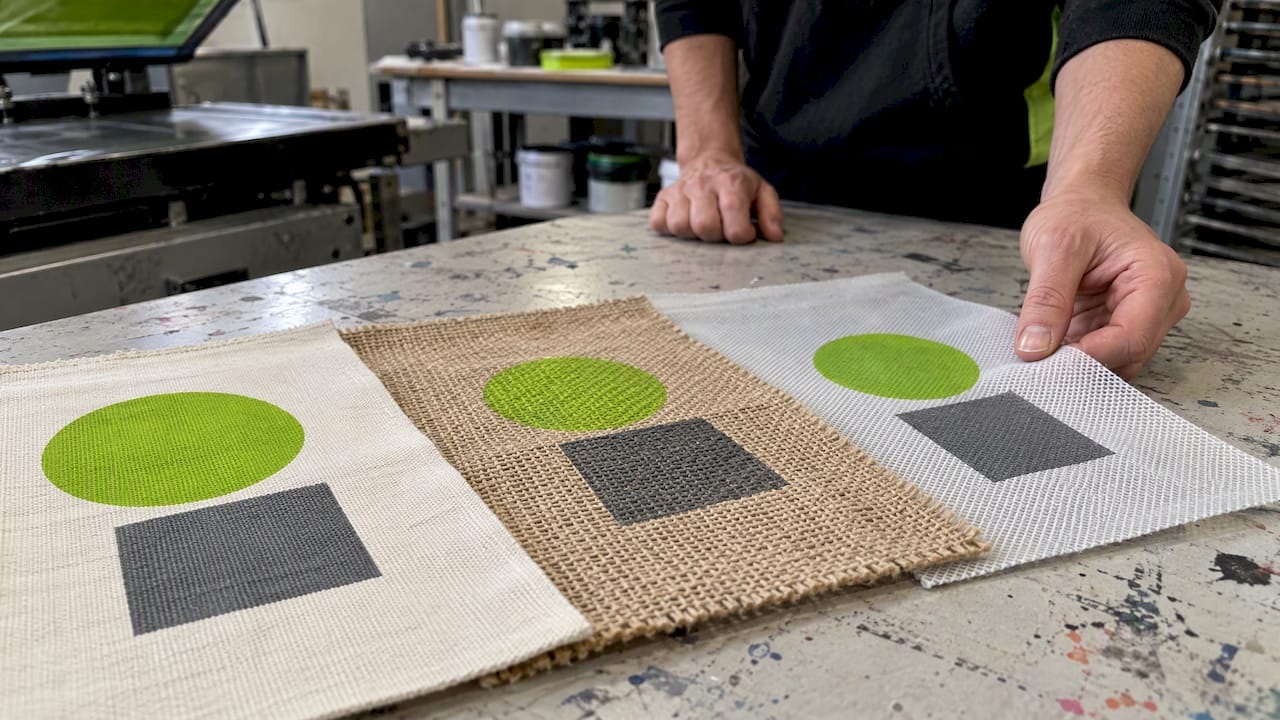
Jute is a coarse natural fiber that is used to make stiff and strong bags. A jute bag is suitable for packaging food and gift baskets, market and shopping bags, and gives a natural look to a brand. The rough surface of jute sets limits for printing, fine details are difficult to reproduce clearly.
Non-woven polypropylene is a material made of compressed fibers instead of woven fabric. It is lightweight, inexpensive, and comes in bright colors. A non-woven bag is a reasonable choice for events with a large number of visitors, but its lifespan is shorter than that of a cotton or jute bag.
rPET and other synthetic fabrics are made from recycled plastic bottles or polyester. They are used to make foldable shopping bags that fit in your pocket, as well as more rain-resistant sports bags and backpacks.
| Material | Strength and lifespan | Printing area | Best use |
|---|---|---|---|
| Thin cotton | Average | Smooth, suitable for most prints | Fairs, conferences, event gift packages |
| Thicker cotton | Good, lasts for years | Very good, also suitable for embroidery | Customer and employee gift |
| Organic or recycled cotton | Depends on fabric weight | Good | A brand focused on sustainability |
| Canvas | Very good | Very good, also large printing area | Premium gift, shoulder bag |
| Jute | Very good, stiff | Rough, suitable for a simple logo | Gift baskets, food packages, market bag |
| Non-woven PP | Shorter | Smooth, suitable for simple printing | Big events, small budget |
| rPET, polyester | Good, lightweight | Smooth | Foldable bags, sports bags |
In addition to tote bags, Logo.ee also offers backpacks, shoe bags, computer, sports and travel bags. The entire selection can be seen on the page Bags with logos for companies.
Size, handles and color according to purpose
A bag will remain in use if it fits the recipient's daily life. Before choosing a material, think about where the person is likely to take the bag.
Size
- A shopping bag should hold the groceries from a typical shopping trip. A small bag that can barely fit a carton of milk and bread will stay in the drawer.
- A trade show and conference bag should be able to hold an A4 folder, brochures, and a bottle. Choose a size that fits A4 flat.
- A gift bag can be smaller if it is intended to wrap a specific gift, such as a bottle, book, or gift set.
- A bag with a bottom is more spacious than a flat carrier bag and is suitable for grocery shopping and gift baskets.
Handles
Long handles allow you to carry the bag on your shoulder and are usually a more comfortable option, especially over a winter jacket. Short handles are suitable for carrying in the hand and for more formal bags. If the bag has to bear weight, make sure the handles are attached with strong stitching and, if possible, cross-stitched. It is the attachment of the handles that usually gives way first.
Color
Natural white or light beige cotton is the most versatile and works well with almost any logo color. For a black or navy bag, keep in mind that a light print on a dark fabric requires a white underbase or a more opaque ink, which can affect the price. A colored bag can be chosen in the company's signature color, but check the fabric color based on a physical sample, as the shade seen on the screen may differ.
Printing and branding methods for tote bags
There are several technologies for applying a logo to a bag. The right choice depends on the number of colors in the design, the fabric, the quantity, and the finish you want to achieve. Logo.ee performs printing, embroidery, and engraving services on its own orders, so you can ask for advice on choosing a technique before the design is finalized.
| Marking method | What is this? | When is it suitable? | What to consider |
|---|---|---|---|
| Silkscreen printing | The color is pressed through a stencil onto the fabric, each color separately. | One- or two-colour logo, larger quantity | Each additional color adds work, no photo effects |
| DTF printing | The design is printed on film and heat-pressed onto the fabric | Multicolor logo, gradient, smaller quantity | Also suitable for dark fabrics, the surface feels like a thin film |
| DTG digital printing | The ink is printed directly into the fabric | Photo design, very small quantity, light-coloured cotton bags | Best on smooth cotton |
| Embroidery | The logo is embroidered into the fabric with thread. | Premium gift, small logo, thick fabric | Fine details and small text need simplification |
| Pad printing and UV printing | Printing on rigid surfaces | Products that come with the bag, such as a pen or bottle | Not used directly on the bag fabric |
How the material affects printing
Smooth, dense cotton or canvas will give the sharpest results and will work with any technique. The rough surface of jute and the structure of non-woven material are better suited for simple, large logos than for fine text. Dark colors can show through on very thin fabrics, so double-sided printing requires a denser material.
A design people want to carry
A large logo all over the bag looks like advertising space and is carried less often. A smaller logo, short phrase or design that is beautiful in itself and has the brand only as a signature will be used more often. If you want the bag to tell the story of the brand, not just bear the name, you can find ideas in the article Visual Storytelling Techniques . It is also a good idea to design one side of the bag for the brand and the other for the recipient: a motif related to the city, an event slogan or a funny illustration.
How green is a reusable bag really?
Cloth bags are often chosen for environmental reasons, but the production of the material has its own footprint. According to the Climate Technology Centre and Network (CTCN)’s Life Cycle Assessment, a cotton bag needs to be used 50 to 150 times before its climate impact equals that of a single-use plastic bag. For a thick polypropylene bag, the same figure is 10 to 20 times, according to the same assessment.
This leads to two practical conclusions. First, a cotton bag is not automatically more environmentally friendly: a bag that stays in the closet does not bring any environmental benefits, because the impact of its production is not offset through repeated use. Second, the most sustainable decision for a company is to order bags that people actually use, and only as many as they need. The same principle is emphasized in the Rohetiiger packaging design guide : the material should be used as little as possible and as much as necessary.
Estonian rules are moving in the same direction. Since the beginning of 2025, textile waste has had to be collected separately , which also includes bags and other accessories. A worn-out branded bag therefore belongs to textile waste collection, not household waste. According to the Ministry of Climate , extended producer responsibility for textile products will apply from 2028. On the packaging side , from 1 January 2030, all packaging placed on the market must be recyclable . If you use bags as shopping bags in your store, it is worth considering these changes in your packaging plan now and asking the packaging organization or the Ministry of Climate for more detailed obligations regarding your activities.
If the bags are part of a company's broader sustainability message, it helps if the claim is specific: what material the bag is made of, why it was chosen, and how it is used. A general "eco" on a bag without content comes across as greenwashing. For more on the business side of sustainable entrepreneurship, read the article Business Benefits of Climate-Neutral Entrepreneurship .
What to check before ordering a large quantity
For larger quantities of logo bags, errors will only be apparent after hundreds of bags have been printed. Please review this list before confirming.
- Purpose and recipient. Is the bag for trade show distribution, employee gift, or customer packaging? The material, size, and budget per piece depend on this.
- Fabric and fabric weight. Ask for the material and fabric weight in writing. When comparing two quotes, make sure you are comparing bags of the same thickness.
- Color and sample: If the fabric color or print color is critical to your brand, ask for a sample or at least a fabric color card before mass production.
- Print area and location. Check the maximum print area of the bag and whether the logo will be on one or both sides. Double-sided printing and additional colors will affect the price.
- Design file. A vector file (AI, EPS, PDF, or SVG) will produce the sharpest results. If you don't have one, ask your designer if they can prepare your logo for print.
- Minimum quantity. Screen printing is usually most cost-effective for larger quantities, while digital techniques are better suited for smaller quantities. Ask what the quantity threshold for a lower unit price is for your quantity.
- What the price includes. Check whether the offer includes prepress, design, packaging, and transportation or whether they are charged separately.
- Delivery time. In addition to production, consider design coordination and sample time. If the bags are needed for a specific event, start early and ask the supplier for a confirmed completion date.
- Packaging and delivery. Will the bags need to be shared between multiple offices or sent directly to the event? Will they need to be bundled with other gifts?
For seasonal campaigns, such as Christmas, spring fairs, or the fall school year, it's worth planning your bag order along with the entire campaign schedule. Tips for planning seasonal campaigns are also helpful for this.
When is a bag with a logo a good promotional gift?
A bag is one of the few promotional products that is a mobile advertising space: every time someone carries it on a bus, in a shop or around town, others see the logo. This makes a bag a good choice if:
- hand out something physical , such as brochures at a trade fair, materials at a conference, or a gift bag at an event, because the bag is also packaging;
- you want a gift that suits everyone , because a bag doesn't have a size or taste preference like clothing;
- your brand message is related to everyday life , such as food, sports, culture or city life;
- The budget is limited, but the quantity is large , because a simple tote bag is affordable and useful at the same time.
A bag alone may seem modest for an employee or a regular customer. Then a set works better: a bag that contains, for example, a bound A5 notebook , a recycled paper pen and a drink bottle. A foldable bag hook that attaches to the edge of a table is also a small but practical addition in the same set as the bag. This way, the gift becomes a thoughtful package, not just a single item.
A bag is not a good choice if the recipients are already full of bags and have no need for a gift, for example if the same target group has already been given bags repeatedly in recent years. In this case, it is worth choosing a different product or making the bag special through material, design or content.
Our view: choose a bag people will keep using
We have been working with promotional gifts since 2004 and have seen that the bags that work best are those that are chosen with the recipient in mind, not just the logo. The most common mistake is to order the thinnest bag with the biggest logo because it is cheaper per piece. The result is distributed widely, but it is rarely worn and the advertising value remains small.
We recommend starting with the question of where and how the person will use the bag, and choosing the material, size and branding accordingly. It is often wiser to order slightly fewer, but thicker and more tastefully designed bags. At the start of the project, we help choose the bag and printing method, create the design and take care of branding, packaging and delivery, so that the customer has one contact for the entire process.
Order your branded bags from one supplier
Logo.ee helps you choose the right bag for your company, from cotton tote bags to backpacks, sports and computer bags. We create a design, choose the right marking for the fabric, whether it's screen printing, DTF or DTG printing or embroidery, pack the order and arrange delivery in Estonia and across Europe. See the full range of promotional gifts or send an inquiry on our website to get a quote based on your quantity and design.
Frequently asked questions
Which print is the most durable on a fabric bag?
Screen printing and embroidery are very durable when done correctly and can withstand daily use and washing. DTF printing is also durable and suitable for multi-color designs. The ultimate durability also depends on the fabric and care, so ask the supplier for washing instructions.
What is the minimum order quantity?
The minimum quantity depends on the bag and the branding method. Screen printing is most reasonable for larger quantities, digital techniques such as DTF and DTG allow for smaller quantities. The exact minimum and price can be obtained upon request.
Is a cotton bag always more environmentally friendly than a plastic bag?
No. According to the CTCN, a cotton bag needs to be used 50 to 150 times before its climate impact equals that of a single-use plastic bag. A cotton bag is a better choice if it is used for a long time, so choose a bag that is strong and has a nice design.
Which file format should I use for the logo?
A vector file, such as AI, EPS, SVG, or vectorized PDF, is best because it will look sharp at any size. If you only have an image file, a designer can usually prepare the logo for print. Also include your brand color codes in the file.
What should you do with a tote bag at the end of its life?
Estonia has been obliged to collect textile waste separately since 2025, which also includes bags. It is worth giving away or reusing a bag that is still in good condition, and taking a worn-out bag to a textile waste collection point. You can find more detailed collection points on your local government's website.
Sources
- Single-use plastic bags and their alternatives: recommendations from life cycle assessments (CTCN)
- Separate collection of textile waste from 01.01.2025 (Environmental Board)
- Extended producer responsibility and problematic products (Ministry of Climate)
- Packaging (Ministry of Climate)
- Packaging Design Guide 2022 (Rohetiiger)