


Logo embroidery on clothing: durable branding, step by step
An embroidered logo is a strong choice for clothing that needs to look professional after repeated washing: polo shirts, jackets, fleeces, caps and everyday workwear. The design is stitched in thread rather than applied as a layer of ink. Choosing suitable thread and following the care instructions helps it stay presentable for longer. This guide explains when to choose embroidery or printing, which fabrics work best, where to place the logo, how to prepare the artwork and how a workwear embroidery order moves from the first enquiry to the finished garments.
In short
- Embroidery is best suited for stronger fabrics and garments that are worn and washed a lot: polos, jackets, fleeces, sweatshirts, hats, workwear.
- Printing is better for large areas, photos, color transitions, and thin T-shirts. For large quantities and large designs, printing is often more affordable.
- The logo must be prepared for embroidery : a vector file, limited number of colors, and simplified fine details will produce a clean result.
- The price is primarily affected by the size of the embroidery and the number of stitches, the number of colors, the number of embroidery positions, and the quantity ordered.
- Logotrade organizes the entire process from one place: garment selection, design, embroidery, packaging, and delivery in Estonia and across Europe.
Table of contents
- What is logo embroidery and how is it different from printing?
- Embroidery or print: which should you choose?
- What clothes and fabrics are suitable for embroidery?
- Where to place the logo
- How to prepare a logo for embroidery
- Workwear embroidery: how the order works
- What affects the price, quantity and delivery time of embroidery?
- How to keep embroidery beautiful for a long time
- Our view: embroidery is a long-term investment in clothing
- Logo embroidery and workwear from one place
- Frequently asked questions
- Sources
What is logo embroidery and how is it different from printing?
Logo embroidery means that the logo is sewn onto the garment with thread using an industrial embroidery machine. Before that, the logo is converted into an embroidery file: the type, direction, density and order of stitches are determined for each shape, and each color gets its own thread. The machine embroiders exactly the same result on each garment according to the file, so the tenth and the hundredth polo shirt look the same.
Textile logo printing, on the other hand, transfers ink to the surface of the fabric or into the fibers of the fabric. The most common techniques are screen printing, where the ink is forced through a stencil, DTF printing, where the design is printed on a film and heat-pressed onto the garment, and DTG digital printing, where an inkjet printer prints directly onto the fabric. Each technique has its own strengths, and this determines which solution is suitable for a particular garment.
The main difference is in the feel and durability. The embroidery is three-dimensional, slightly embossed and gives the garment a dignified, “official” look. It withstands abrasion and washing well because the color is in the thread, not on the surface of the fabric. The print is flat and soft, allows for fine details, photos and color transitions, and can cover a large area, such as the entire back, if desired.
Embroidery or print: which should you choose?
The most common question we get asked is: should we embroider or print? The answer depends on the garment, the design, the quantity, and how long and how intensively the garment will be worn.
| Criterion | Embroidery | Silkscreen printing | DTF printing | DTG digital printing |
|---|---|---|---|---|
| Appearance | Raised, professional finish | Flat, vivid full colors | Flat, sharp detail | Soft, photo quality |
| Durability in washing and wear | Very good | Good | Good | Average to good |
| Fine details and small text | Limited | Good | Very good | Very good |
| Photos and color transitions | Not suitable | Limited | Suitable | Well suited |
| Large design (e.g. on the back) | Expensive and heavy | Well suited | Suitable | Suitable |
| Suitable fabrics | Pique, fleece, softshell, cotton twill, terry | Cotton, blended fabrics, bags | Very different fabrics | Mainly cotton |
| Where it works especially well | Polos, jackets, hats, workwear | Large T-shirt runs | Small and medium quantities, multi-color logos | Small quantities, complex designs |
Choose embroidery if the garment is intended for daily wear and frequent washing, if the fabric is thicker or structured (pique, fleece, softshell), and if the logo is in a smaller format on the chest, sleeve, or hat. Embroidery is a natural choice for customer service representatives, sales teams, hotel and restaurant staff, and anyone else who represents the company directly to the customer.
Choose print if the design is large, contains a photo or smooth color transitions, if the garment is thin and stretchy, and if you are ordering a large production run for a one-time event. We write more in-depth about the techniques in the articles screen printing on textiles and products and DTG digital printing on garments .
Often the best solution is a combination of a small embroidered logo on the chest and a larger print on the back. This gives the garment a representative look and a legible message, such as the name of the event or the team.
What clothes and fabrics are suitable for embroidery?
Embroidery needs a base that can support the weight of the thread and the density of the stitches. The more stable the fabric, the cleaner and longer-lasting the result.
Well suited:
- Polo shirts made of pique fabric: a classic choice for a chest logo.
- Jackets and softshell jackets: suitable thread and workmanship give durable embroidery; check separately whether the garment’s waterproofing is preserved.
- Fleeces and sweatshirts : Thick fabric also carries larger embroidery.
- Caps and winter hats: the front panel of a cap is a common embroidery position.
- Work clothes : work pants, work vests, overalls, aprons and chef jackets that are washed frequently and at higher temperatures.
- Bath sheets, towels and bathrobes : terry cloth gives embroidery a soft and high-quality look.
- Bags and backpacks made of strong fabric.
Be careful with thin and very stretchy materials, such as thin knitwear, sports shirts and thin viscose blends. Embroidery on such fabrics can wrinkle or pull the fabric together. If the garment is more stretchy, use a stronger stabilizer and a simpler design under the embroidery, or we recommend printing instead. For jackets with a waterproof membrane, it is worth considering that the needle will make holes in the fabric, so it may be wiser to embroider the logo on the pocket flap or use a separate embroidered emblem.
Where to place the logo
The placement affects both the appearance and the price, as each additional spot means separate setup and embroidery. The most common options are:
| Placement | What is it suitable for? | What to keep in mind |
|---|---|---|
| Left chest | Polos, shirts, jackets, fleeces | The most classic location, the logo is immediately visible during face-to-face conversation |
| Right chest | Workwear, combined designs | Suitable for a name or another logo if there is already a company logo on the left |
| Sleeve or shoulder | Jackets, polos, workwear | Good place for an additional badge, web address, or certification badge |
| Nape | Polo shirts, sweatshirts | Discreet brand or team badge |
| Back | Jackets, fleeces, workwear | Larger embroidery is more expensive, for large designs consider print |
| Front of cap | Caps | The seam in the middle requires design adjustments |
| Towel edge | Sauna towels, bath sheets | The logo is usually embroidered in the center of one end |
For a chest logo, a moderate size usually works: large enough to be recognizable from a few meters away, but not so large that it dominates the entire garment. We always adjust the exact size based on the type of garment, fabric, and shape of the logo, as a wide horizontal logo and a square logo require different approaches.
How to prepare a logo for embroidery
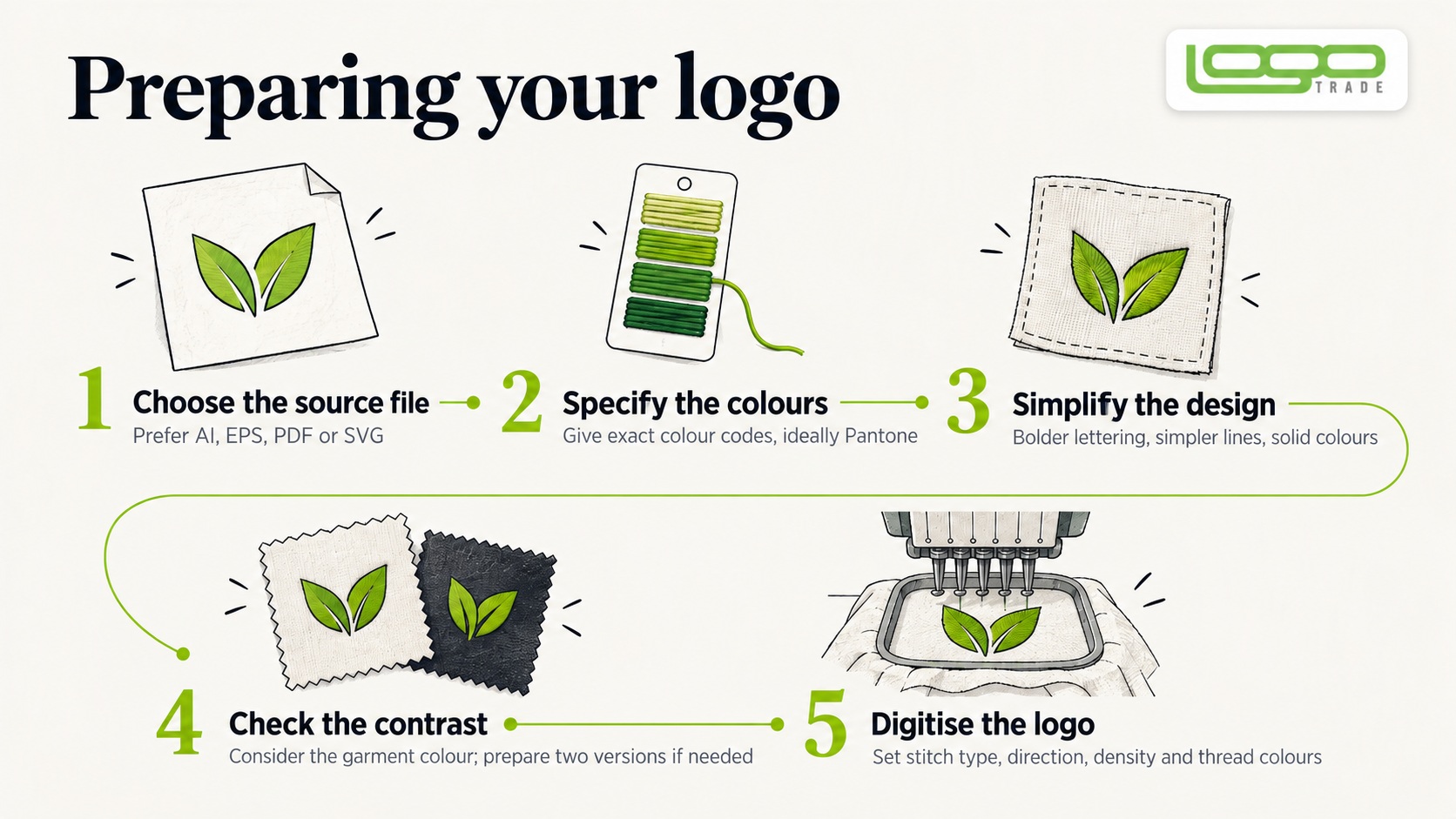
Good embroidery starts with a good file. The clearer the source material, the faster the embroidery file will be ready and the cleaner the result.
File format. A vector file is best: AI, EPS, PDF or SVG. A vector file shows the exact shapes and lines of the logo and can be enlarged or reduced without loss of quality. If a vector file is not available, a high-resolution PNG is also suitable, but then the artwork must be redrawn clearly before embroidery.
Colors. Provide the exact color codes of the logo, preferably Pantone codes. Thread colors are chosen to be the closest to these from the thread chart. In embroidery, each color is a separate thread, so it is worth keeping the number of colors reasonable. Very similar shades are often worth combining into one.
Details. The thread is thicker than the ink line. Very fine text, hair-thin lines, shadows and color transitions do not come out in embroidery as they do on screen. The solution is an embroidery version of the logo: simplified lines, slightly thicker lettering and solid colors instead of transitions. Many large brands have a separate logo version designed for embroidery.
Background and contrast. Consider what color of clothing the logo will go on. A dark logo on dark fleece will be lost, in which case a lighter or solid-color version will work. If the logo is used on both light and dark clothing, it is helpful to coordinate two color schemes at once.
Digitization. The logo is translated into the language of the embroidery machine: each area gets a stitch type (for example, satin stitch for the lettering and edges, fill stitch for larger areas), direction and density. This work is done once and the same file can be used for subsequent orders. If you do not have a proper file of the logo or it needs to be redesigned, our advertising and print design team will help prepare it.
Workwear embroidery: how the order works
When it comes to workwear, it's not just the logo that's important, but also that the garment fits the job, the sizes match, and that reordering is easy later. This is how our order usually goes:
- Inquiry and needs mapping. You tell us who the clothing is for, what environment it will be worn in, how many people there are and when the clothing is needed. Polo shirts for the office team and work vests for warehouse workers require very different solutions.
- Clothing selection. We offer suitable models, fabrics and colors. Also see our selection of workwear and promotional gifts .
- Logo and layout. You send the logo file, we agree on the layout, size and thread colors. If necessary, we will adjust the logo to be suitable for embroidery.
- Visual and quote. You will receive a visual showing the location and size of the logo on the garment, as well as a quote based on quantity and placements.
- Confirmation and size breakdown. You approve the design and send the quantities required in each size. For larger orders, it is worth having employees try the sizes before you confirm them.
- Embroidery and quality control. The garments are embroidered and checked to ensure that the logo location, colors, and stitches match the approved design.
- Packaging and delivery. On request, we pack the garments by employee or department and deliver them within Estonia or elsewhere in Europe.
If you plan to order additional garments later, for example for new employees, remember the approved model, color, and embroidery file. This will make reordering quick and the new garments will resemble the originals.
What affects the price, quantity and delivery time of embroidery?
The price of embroidery does not depend only on the garment. Consider these factors:
- Embroidery size and number of stitches. The larger and denser the embroidery, the longer the machine will run. A chest logo is significantly more affordable than a large back embroidery.
- Number of colors. Each color is a separate thread and a separate step on the machine, although today's multi-needle machines have less of an impact than in the past.
- Number of placements. The chest, sleeve and nape are three separate embroidery positions.
- Quantity. The setup and embroidery file creation is a one-off cost spread across the production quantity. Therefore, the price per garment is lower for larger orders.
- Clothing selection. The price difference from a basic model to a high-quality softshell jacket is large and often accounts for the majority of the total cost.
- Speed. If the clothing is needed urgently, the delivery time depends on whether the selected model and sizes are in stock.
For large designs and large runs, printing is often more cost-effective than embroidery, while for smaller logos and frequent wear, embroidery pays off with durability. You will receive the exact price and delivery time based on your specific request, as they depend on the garment, logo and quantity.
Plan ahead. Embroidery work is usually most busy around Christmas, summer events, and the start of the season when workwear is being updated. If you know you need the clothes for a specific date, get in touch as soon as the event date is set.
How to keep embroidery beautiful for a long time
Embroidery is durable, but it also requires reasonable care. Always follow the garment's care label: the symbols are internationally harmonized and their system is described in the EVS-EN ISO 3758:2024 standard, which helps you choose the appropriate washing and care method.
Practical recommendations for employees:
- Turn the garment inside out before washing so that the embroidery rubs less against other items.
- Avoid strong bleaching agents, as they can discolor the thread.
- Iron on the wrong side of the embroidery or through the fabric, not directly on the embroidery.
- Do not pull the loose ends of the thread from the embroidery, but carefully cut them off.
For workwear that will be washed in an industrial laundry, please let us know when selecting the garment and embroidery. We will then select a model and thread that can withstand such care.
Our view: embroidery is a long-term investment in clothing
We have been in the business of promotional gifts and corporate clothing since 2004 and have seen that the most disappointing thing is not bad embroidery, but the wrong choice: a large detailed logo on a thin T-shirt or an overly fine line of lettering on a hat. That is why we start every project by asking who will wear the garment and for how long. If the answer is “our team every day for the next two or three years”, embroidery is almost always the right choice.
We don't recommend embroidery at all costs. If you need a lot of colorful shirts for an event, we'll tell you straight up that printing is better and cheaper. Often the best result comes from a combination: an embroidered logo on the chest adds dignity and a print on the back conveys a message. Since we offer embroidery, screen printing, DTF and DTG printing ourselves, we can recommend a solution without biasing in favor of one technique.
Another thing we emphasize: do the embroidery version of the logo properly once. A well-digitized file will serve you for years, and a follow-up order with the same garment, thread, and settings will remain as similar as possible to the first order. Personal advice and a project-based approach mean that we will think about the next order with you.
Logo embroidery and workwear from one place
Logotrade helps you choose a garment, adapts the logo to be suitable for embroidery, embroiders it on polo shirts, jackets, hats or work clothes, and packs and delivers the finished garments in Estonia and across Europe. If you want other products with your logo in addition to the garments, the entire order can be arranged through one contact.
Check out our logo embroidery and printing services and send us a request: describe the garments, quantity and deadline, and we will propose a suitable solution. For more examples of embroidery on polo shirts, jackets and hats, see our service page logo embroidery on garments .
Frequently asked questions
Is embroidery or print more durable?
Embroidery is generally durable because the design is formed from thread rather than a surface layer of ink. Printing can wear over time with frequent washing and abrasion. The result still depends on the fabric, thread, workmanship and care; on thin, stretchy materials, a well-made print may be the better choice.
What file is needed to embroider a logo?
A vector file in AI, EPS, PDF or SVG format with color codes is best. If you don't have a vector file, a high-resolution PNG is suitable, from which we will create an embroidery file. Very fine details and color transitions need to be simplified for embroidery.
Can employee names be embroidered?
Yes, names can be embroidered in a separate place, for example on the right chest opposite the logo. In this case, each garment will be slightly different, so we need an exact list of names and sizes with the order. It is advisable to write the names in a simple and easily legible font.
Can embroidered clothes be washed at high temperatures?
Care must be appropriate for both the garment and the embroidery thread used. Follow the care instructions on the garment's care label and the embroidery. Turn the garment inside out when washing and avoid bleaching agents. If the workwear is washed industrially, please state this when ordering so that we can select the appropriate garment and thread.
Can I embroider the logo on my own clothing?
In many cases, yes, but the fabric must be suitable for embroidery and the garments must be clean and uniform. It is easier and safer to choose garments from our selection, because then we know the material and can assess the suitability of the overall solution. Describe the garments in your inquiry, and we will let you know what is possible.