


DTF printing on workwear: how it works and when to choose it
DTF printing is a good choice for workwear when the logo is colorful, detailed, or small, and there are several different types of clothing: T-shirts, fleeces, softshell jackets, caps. The design is first printed on film and then heat-pressed onto the fabric. This way, the same logo can be applied to a wide variety of materials, including polyester and blended fabrics, which are more difficult to reach when printing directly onto clothing. Properly done and properly maintained, DTF printing can withstand frequent washing of workwear. Below, we describe how the process works, which garments DTF is suitable for, how it differs from embroidery and screen printing, and what to consider when preparing an order.
In short
- DTF stands for direct to film : the logo is printed on film, coated with adhesive powder, dried and heat-pressed onto the garment.
- The method is suitable for many fabrics, provided that the compatibility of the garment and the transfer material has been checked: cotton, polyester, blended fabrics and synthetic fibers, both light and dark garments.
- For workwear, DTF is especially good for full-color logos, transitions, fine details, and smaller runs.
- Durability depends on the quality of the film and powder, and washing: wash inside out, in cooler water, without bleach, and do not iron directly onto the print.
- Embroidery is suitable for more polished clothing, screen printing for large one- or two-color runs, and DTF for mixed orders where the clothing and materials are different.
Table of contents
- What is DTF printing and how does the logo get onto clothing?
- Why DTF is suitable for workwear
- What garments and fabrics is DTF suitable for?
- Printing locations and logo size
- DTF, Embroidery or Screen Printing: How to Choose
- How long does DTF printing last and how to maintain workwear
- What to consider when ordering DTF printed workwear
- Our view
- Workwear with logo from one place
- Frequently asked questions
- Sources
What is DTF printing and how does the logo get onto clothing?
DTF is digital transfer printing. Unlike direct-to-garment printing, the printer does not come into contact with the fabric at all: all the work is done on the film, and the garment only receives the finished design at the last stage. According to the description on Epson's Estonian website, the design is printed on the film, then powder is applied and hardened, and finally the film, together with the powder, is pressed onto the garment with heat.
The usual workflow looks like this:
- File and preparation. The logo is placed in the print file at the correct size. On dark garments, a white base layer is added under the colors to keep the tones vibrant.
- Printing on film. A special printer prints the design in mirror image on PET film.
- Adhesive powder. A hot-melt powder is sprinkled onto the wet ink, which sticks only to the printed areas.
- Drying. The powder is melted and hardened so that a uniform adhesive layer is formed on the film.
- Pressing. The film is placed on the garment and pressed with a heat press. The heat and pressure bond the adhesive layer to the fabric fibers.
- Film removal. The film is pulled off, leaving a thin, flexible print on the garment.
Since the design is completed before it reaches the garment, chest logos, sleeve logos and back prints can be cut from a single sheet of transfer film and applied to different garments. This is a big advantage for workwear: the same logo goes on a shirt, fleece and hat with the same color and detail. We have described the strengths of the method in more detail in the article Advantages of DTF transfer printing .
Why DTF is suitable for workwear
Workwear is not a campaign shirt that is worn a few times. It is washed frequently, subjected to physical work, exposed to rain, abrasion and dirt. The logo must remain legible and the brand colors correct even after months of use. The strengths of DTF in workwear are as follows.
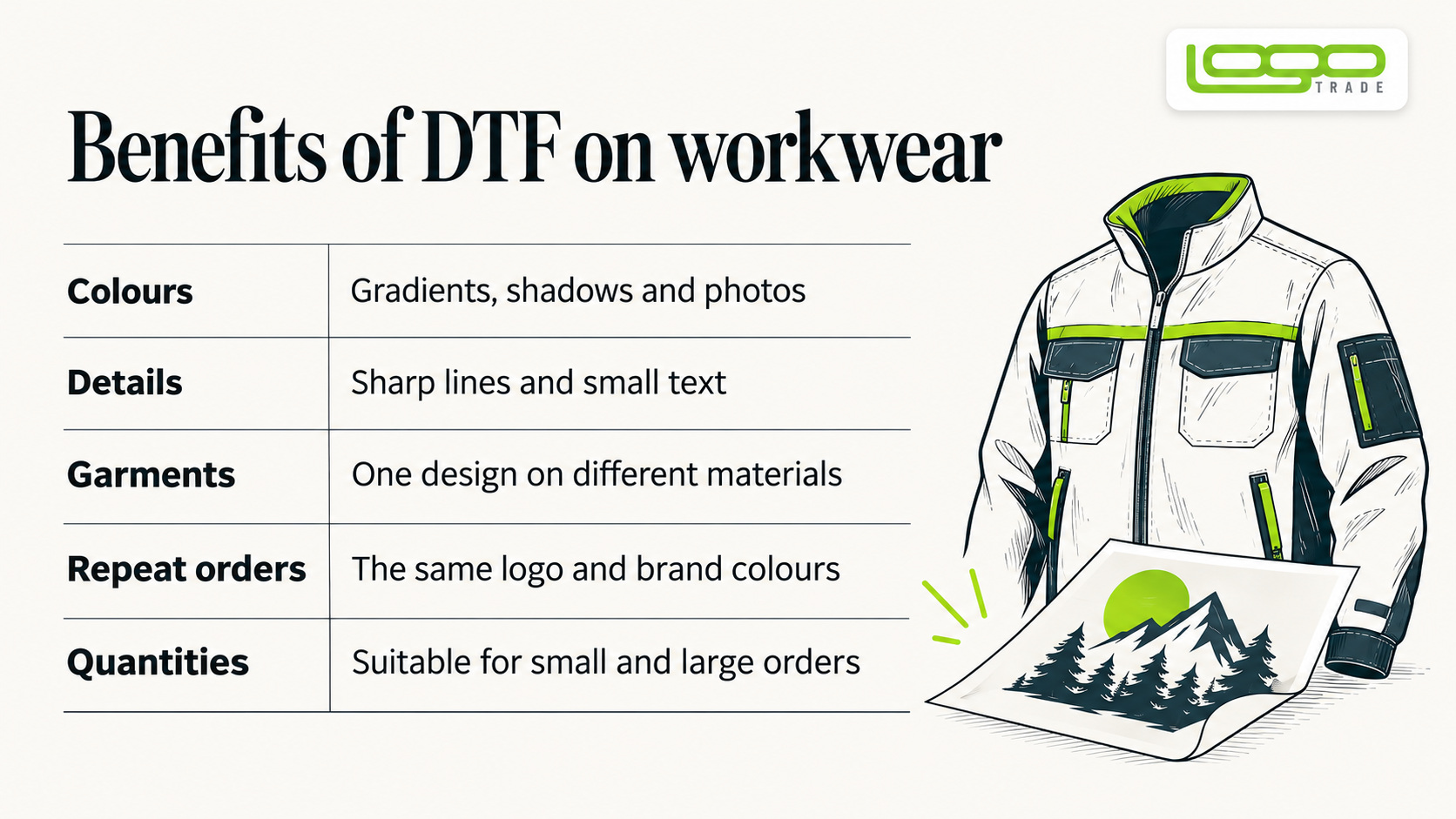
Full color without the extra work. A logo can contain multiple colors, gradients, shadows, or a photo. There is no need to make a separate stencil for each color, as with screen printing, so a complex logo doesn't make a small order unreasonably laborious.
Fine details and small text. Thin lines, small fonts, and contours come out sharp with DTF. This is important, for example, when the logo includes the company's website address, phone number, or safety-related information.
Different garments in one order. A workwear set often consists of different materials: cotton T-shirt, polyester fleece, softshell, cap. With DTF, you can brand all of them with the same design.
Consistent brand image even on repeat orders. As the team grows and new clothing is needed, the logo needs to look the same as the last time. Mimaki’s workwear printing overview also highlights that the same logo and brand colors need to look the same on shirts, jackets, safety clothing and repeat orders. A digital file and film printing help to repeat the result.
Flexible quantity. Because there are no templates and expensive setup, DTF is suitable for both a small team and a larger order where quantities of different sizes and models vary.
What garments and fabrics is DTF suitable for?
The biggest advantage of DTF over direct-to-garment printing is the choice of materials. According to Epson, DTFilm is suitable for almost any fabric, while direct-to-garment printing, or DTG, is best suited for cotton. The same source notes that DTF is also useful for small logos in areas that are more difficult to work with when printing directly to the garment. According to material suppliers, DTF printing is applied to both light and dark fabrics , including cotton, polyester, 50/50 blends, nylon and canvas.
| Workwear | Typical fabric | DTF suitability |
|---|---|---|
| T-shirt, polo shirt | Cotton, blends | Suitable after a compatibility check, on chest or back |
| Hoodie, sweatshirt | Cotton-polyester | Suitable after a compatibility check, including larger back prints |
| Fleece jacket | Polyester fleece | Use a smooth area; test first |
| Softshell jacket, windbreaker | Polyester, membrane fabric | Check coating and heat tolerance; test first |
| Work vest, overalls | Cotton, polyester, blends | Check garment suitability and logo placement |
| Cap | Cotton, polyester | Small front logo if the panel and press are suitable |
| Fabric bag | Cotton, canvas | Suitable after a compatibility check |
A few practical notes. On very fluffy or heavily textured surfaces, the print will be less uniform than on smooth fabrics, so on fleece and knitwear, we choose a smooth spot or a smaller size for the logo. On heat-sensitive and water-resistant coated fabrics, the pressing temperature and time must be selected according to the material. For protective and high-visibility clothing, we check the clothing manufacturer's permitted marking area and that the logo does not reduce the required visible surface or impair the protective properties. On polyester, color migration must be taken into account, and on nylon and coated fabrics, the suitability of the adhesive and heat sensitivity. If necessary, we will do a test print.
If you want to select and mark garments at the same time, check out our workwear range . For example, a men's full-zip fleece jacket , a women's full-zip fleece jacket and a Level knit hat make a complete outfit for your team. Level is a knit hat; you need to choose a separate marking method for it, and don't assume the same DTF solution will work as for a smooth fabric.
Printing locations and logo size
A logo on workwear has two tasks: it must be easily legible and must not interfere with work. The most common placements are these.
- Chest logo on the left or right chest. A classic and representative choice that is legible even when communicating up close.
- Back print. A larger logo or company name that can be seen from a distance, such as on a construction site, in a warehouse, or at an event.
- Sleeve. A good place for a secondary designation, web address, or department name.
- Neck or nape. Small logo or lettering that remains discreet.
- Hat. Front panel for a smaller logo.
The chest logo is usually about the width of a palm, while the back print can cover a large part of the back. Keep in mind that pockets, seams, zippers and reflective strips limit the usable surface. Therefore, it is worth looking at the specific model before ordering, not just the general size. If there are several different garments in the set, we will adjust the size of the logo for each garment so that it looks proportional everywhere.
DTF, Embroidery or Screen Printing: How to Choose
There are three main methods used to mark workwear. Each has its place and is often used together in a single set.
| Criterion | DTF printing | Embroidery | Silkscreen printing |
|---|---|---|---|
| Colors | full color printing, including transitions and photos | limited number of thread colors | each color is a separate stencil |
| Fine details | very good | small text is more complicated | good if the design is clear |
| Suitable quantity | from small quantities | small to large | especially larger print runs |
| Materials | many fabrics; suitability must be checked | thicker and denser fabrics | especially cotton and blended fabrics |
| Appearance | thin, soft, flat with fabric | raised, professional | smooth print layer; feel depends on ink and fabric |
| Typical use | mixed orders, colour logos | jackets, polos, hats, formal wear | large single-color orders |
Choose DTF if the logo is multi-colored, contains gradients or fine text, if the garments are made of different materials, or if the quantity is smaller and divided into different models.
Choose embroidery if you want a representative and three-dimensional result on thicker clothing, such as fleece, softshell, polo shirt or hat. Embroidery has a dignified effect in customer service and management clothing.
Choose screen printing if you are ordering a large quantity of the same garment with a one or two color logo. This will spread the work of making stencils across a large number of garments.
In practice, a combination of chest logo embroidery on a jacket and larger DTF back print on T-shirts is often suitable. You can find a comparison of all methods in our logo application methods guide and article on promotional gift printing methods .
How long does DTF printing last and how to maintain workwear
Durability is the most important issue when it comes to workwear. According to Epson Estonia, DTFilm prints can last as long as the garment itself, but actual durability depends on the type of film and powder, and how the garment is cared for. According to material suppliers, a high-quality DTF print can typically withstand 40 to 50 washes or more without noticeable loss of quality or cracking, if properly cared for.
To keep your logo looking good for a long time, share these simple rules with your employees:
- Wash the garment inside out. This will reduce the friction of the print in the drum.
- Choose a cooler wash and mild detergent. High heat and aggressive chemicals will wear down the adhesive layer faster.
- Do not use bleach. This will damage both the print and the fabric.
- Dry according to the garment and print supplier’s care instructions. Hang drying is often preferable; only tumble-dry if the instructions permit it.
- Do not iron directly on the print. Follow the print supplier’s instructions, including any permitted ironing from the reverse.
- Wait before the first wash. Follow the transfer supplier’s specified waiting period after pressing.
If your workwear is being washed in an industrial laundry, please let us know when you place your order. We can then select the garment and branding method that best suits your washing regimen.
What to consider when ordering DTF printed workwear
A well-prepared order saves time and gives a better result. These are the questions we go through at the beginning of every workwear project.
1. Logo file. A vector file (AI, EPS, SVG or vector PDF) is best because it can be enlarged to the size of both the hat logo and the back print without loss of quality. If you only have a PNG or JPG, it must be of sufficient resolution. Read more in the articles logo file format for print and vector logo for print . If you don't have a suitable file, our design service will help you arrange it.
2. Brand colors. Provide the exact color codes for your logo, such as Pantone, CMYK, or HEX. On dark clothing, a white base layer helps the colors appear true.
3. Clothing and materials. Write down which clothing items are included in the set and what material they are made of. This will determine whether everything can be done with DTF or whether embroidery is better for some items.
4. Size breakdown. Collect employees’ clothing sizes before ordering. Allow for spare garments and future new starters.
5. Placement and dimensions. Decide whether the logo will go on the chest, back, sleeve, or multiple locations. We will confirm the placement on the design draft before production.
6. Conditions of use. Will the garments be worn in an office, warehouse, construction site, or outdoors? Will they be washed at home or in a commercial laundry? These answers will help you choose the right garment and method.
7. Repeat orders. If you plan to reorder garments over time, we will retain the design and layout data so that the next batch will look the same.
Our view
When ordering workwear, we are most often asked whether DTF is durable enough. Our experience shows that the whole solution is important: the right garment, the right method and the right placement. That is why we do not start with the printing method, but with who will wear the garment, where and how often it will be washed.
DTF is one of our most flexible tools, especially for workwear. It allows the same colorful logo to be applied to a cotton shirt, fleece, and hat, so the team looks unified even if the clothing is made of different materials. If the garment needs a more polished look, we also offer embroidery, and for large single-color runs, screen printing.
We have been operating in the field of promotional gifts and corporate products since 2004 and organize the entire process from one place: we help you choose clothes, create designs, apply the branding, pack and deliver your order both in Estonia and across Europe. This way, you don't have to look for a clothing supplier, designer and printing house separately.
Workwear with logo from one place
If you need workwear with a logo for your team, we will help you choose the right clothes, create a design and apply the logo using DTF printing, embroidery or screen printing, depending on the garment and use. We will pack and deliver the order in Estonia and across Europe.
Explore our printing and branding services and send us an inquiry with your logo, garments and quantities. We will offer a suitable solution for your project.
Frequently asked questions
Is DTF printing also suitable for dark workwear?
Yes. A white base layer is printed under the colors, so the logo colors remain vibrant even on black, navy blue, or gray clothing. This makes DTF a good choice for dark workwear with a colored logo.
Does DTF printing feel stiff or thick on the garment?
High-quality DTF printing is thin, flexible and slightly stretchy, so it moves with the fabric. A larger solid surface feels more substantial in the hand than a subtle logo, so we design a light, airy layout for large back prints when necessary.
Can DTF be used to print on polyester and softshell garments?
Yes, DTF is suitable for many fabrics once the compatibility of the garment and transfer material has been checked, including polyester, blended fabrics and nylon. For heat sensitive and coated materials, we select the pressing temperature and time according to the specific garment.
What is the difference between DTF and DTG?
DTG prints the design directly onto the garment and is best suited for cotton. DTF prints the design onto a film and then presses it onto the garment, making it suitable for a much wider range of materials. We offer both methods and recommend the most suitable one for your garment.
What file should I send the logo as?
A vector file is best, such as AI, EPS, SVG or vector PDF. If you only have a raster file, it must be of high enough resolution, and if there is no suitable file, we will help prepare it as a design service.
Sources
DTFilm and DTG printing | Epson Estonia Custom workwear and logo printing | Mimaki Europe DTF - FAQ | Best Sub Europe
Recommendations
- DTF transfer printing: advantages and areas of application
- Textile printing vs. embroidery on corporate clothing – which one to choose?
- Printing methods for promotional gifts – which one to choose?