Fristads 2595 LWS stretch work trousers, black
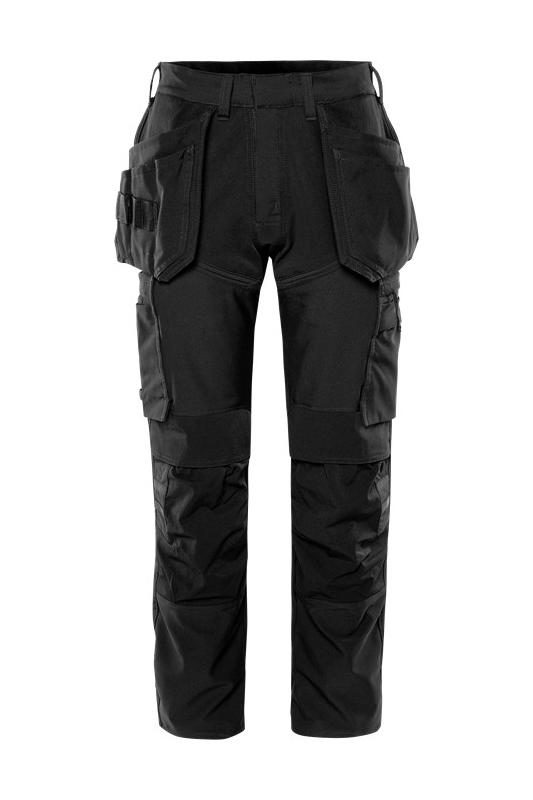
Craftsman trousers made of lightweight 4-way stretch materials for great freedom of movement. Comfortable workwear trousers with ripstop stretch reinforcements, stretch knee pockets and all the functional pockets you need. • Material: Stretch 92% polyester, 8% elastane. Ripstop stretch 87% polyamide, 13% elastane • Weight: Stretch 205 g/m². Ripstop stretch 250 g/m² • Lightweight 4-way stretch fabric • Durable ripstop 4-way stretch panels at upper front and back • Elastic waist at sides • 2 loose-hanging reinforced pockets, one with 3 smaller pockets and tool loops, one with extra pocket • Concealed front button • 2 front pockets • 2 back pockets with zip • Double reinforced crotch seam • Hammer loop • Folding rule pocket in ripstop stretch, leg pocket with snap fastening, pocket with zip, pen pocket, 2 tool pockets and button and loop for sheath knife • Leg pocket with snap fastener, pocket with zip, mobile phone pocket and ID card pocket with flap, D-ring under flap • Ripstop stretch knee pockets with outside opening from above with velcro fastening • Height adjustment for knee pads in knee pockets • Reflective details at knees and leg ends • Ripstop reinforced leg ends • Approved according to EN 14404 together with kneepads 124292 • OEKO-TEX® certified Size: C44 - C66
- Minimum quantity: 1 pcs
- Categories: Custom Clothing & Textiles, Sports & Performance wear, New High-End Corporate Gifts & Luxury Promo Products
Frequently asked questions
What products are included in custom clothing and branded textiles?
The range includes T-shirts, polo shirts, sweatshirts, fleece, vests, softshells, jackets, sportswear, workwear, shirts, headwear, aprons, towels, blankets and other textiles. Fabric, fit, sizes and branding area vary by product.
How should we choose clothing for staff, an event or a gift?
For daily work, prioritise fit, movement and care; for events, consistent colours and visible branding; for gifts, comfort and relevance to the recipient. Check job-specific requirements separately because promotional clothing is not automatically certified protective wear.
Should we use embroidery, screen printing, DTF or transfer printing?
Embroidery often suits structured garments and a compact logo, screen printing can suit larger quantities and limited-colour artwork, while DTF or transfer can suit detailed multicolour designs. The fabric, artwork, print area, quantity and care requirements determine the method.
Which logo file is needed for textile branding?
A vector AI, EPS, PDF or SVG file with confirmed colours usually gives the best starting point. Raster artwork must have sufficient resolution and a suitable background; embroidery also requires a product-specific stitch file.
How do we choose the right sizes, fits and colours?
Use the size chart for the exact garment because sizing varies between brands. Combine men's, women's and unisex fits when appropriate, and confirm colours from a sample or product reference while allowing for possible batch variation.
Can garments carry employee names or different logos?
Individual names, departments or artwork variants are possible on many items, but the method, position and surcharge are product- and quantity-specific. The personalisation list must be checked and approved before production.
What are the minimum order quantity and price?
MOQ and price depend on the garment, colour, size split, stock, branding technique, artwork size, number of positions and packaging. For an accurate quote, provide the use case, quantity, sizes, artwork, budget, destination and deadline.
How long do branded garments take to produce and deliver?
Lead time depends on stock, size availability, branding method, quantity, proof approval and destination. For a fixed event, allow separate time for sourcing, proofing, production, quality control and transport.
Can we approve a sample or digital proof before production?
A digital artwork proof showing position and approximate size is approved before production. Physical garment or decorated sample availability, cost and lead time are product-specific, and a stock sample may not include the final branding.
How should branded clothing be washed and cared for?
Follow both the garment care label and the branding care guidance supplied with the order. Temperature, tumble drying, ironing and dry cleaning limits vary by fabric and by printing or embroidery technique.
How can organic, recycled or textile-safety claims be verified?
Check the material specification and certificate for the selected product, and request supplier evidence when needed. GOTS, OEKO-TEX, organic or recycled-content claims should only be used when documented for that product and supply chain.