


Screen printing on clothing: when it pays off and how to order
Screen printing is a good choice when the same logo or design goes onto dozens or hundreds of T-shirts, sweatshirts or work garments and uses only a few colours. It produces a bold, vibrant and durable print, with a lower cost per print as the quantity increases. For small quantities, multicolour photographs or individual names, DTF printing or embroidery may be a better option. This guide explains the screen-printing process, when it becomes cost-effective, what the printer needs from your artwork and how to care for printed clothing so the logo lasts.
In short
- In screen printing, the ink is pressed directly onto the fabric with a squeegee through a fine mesh, and a separate screen is made for each color.
- The biggest advantage is durability, bright colors, and low unit cost in large quantities; however, preparation takes time and smooth transitions are difficult to print.
- Cotton fabric gives the cleanest results, synthetics and blended fabrics require the appropriate color and drying mode.
- DTF printing is better suited for small quantities, designs with many colors, and personalization.
- Reordering is faster and cheaper if you still have the screens and files.
Table of contents
- How screen printing works on clothes
- Advantages of screen printing
- Limitations to know before ordering
- What clothes and materials is screen printing suitable for?
- Screen printing or DTF printing: which one to choose?
- Screen printing on non-textile promotional products
- Design file and print run: what the printing house asks of you
- How to care for screen-printed clothes
- Our view: start with the use, not the method
- Order screen printing via Logo.ee
- Frequently asked questions
- Sources
How screen printing works on clothes
Screen printing is a printing technology where an image is transferred to a surface using a mesh material . When printing on textiles, the ink is pressed with a squeegee through a fine-woven fabric stretched over a frame, the frame is placed on the fabric with a stencil, and finally the ink is fixed with heat . The name comes from the time when silk was used as the mesh, today the mesh is synthetic, and printing is not only possible on silk fabrics.
In an industrial printing house, the process looks like this:
- Separating the design into colors. The logo is divided into layers of colors because each color is printed separately. A three-colour logo requires three screens.
- Preparation of the frames. The mesh is coated with a light-sensitive emulsion, dried, and illuminated through a film with a design on it. The unexposed areas are washed out, creating a stencil through which the ink can pass.
- Color mixing. The brand color is pre-mixed, often according to a Pantone code, so that the logo looks the same on every product.
- Printing. The fabric is mounted on a printing bed, a frame is placed on top, and a squeegee draws the ink through the mesh. For multi-color designs, the layers are printed one after the other in precise position.
- Drying and fixing. The ink is heated to bond to the fiber and withstand washing.
Preparation is what makes screen printing expensive for small quantities, and the same preparation makes large runs affordable: once the frame is ready, each subsequent shirt goes quickly.
Advantages of screen printing
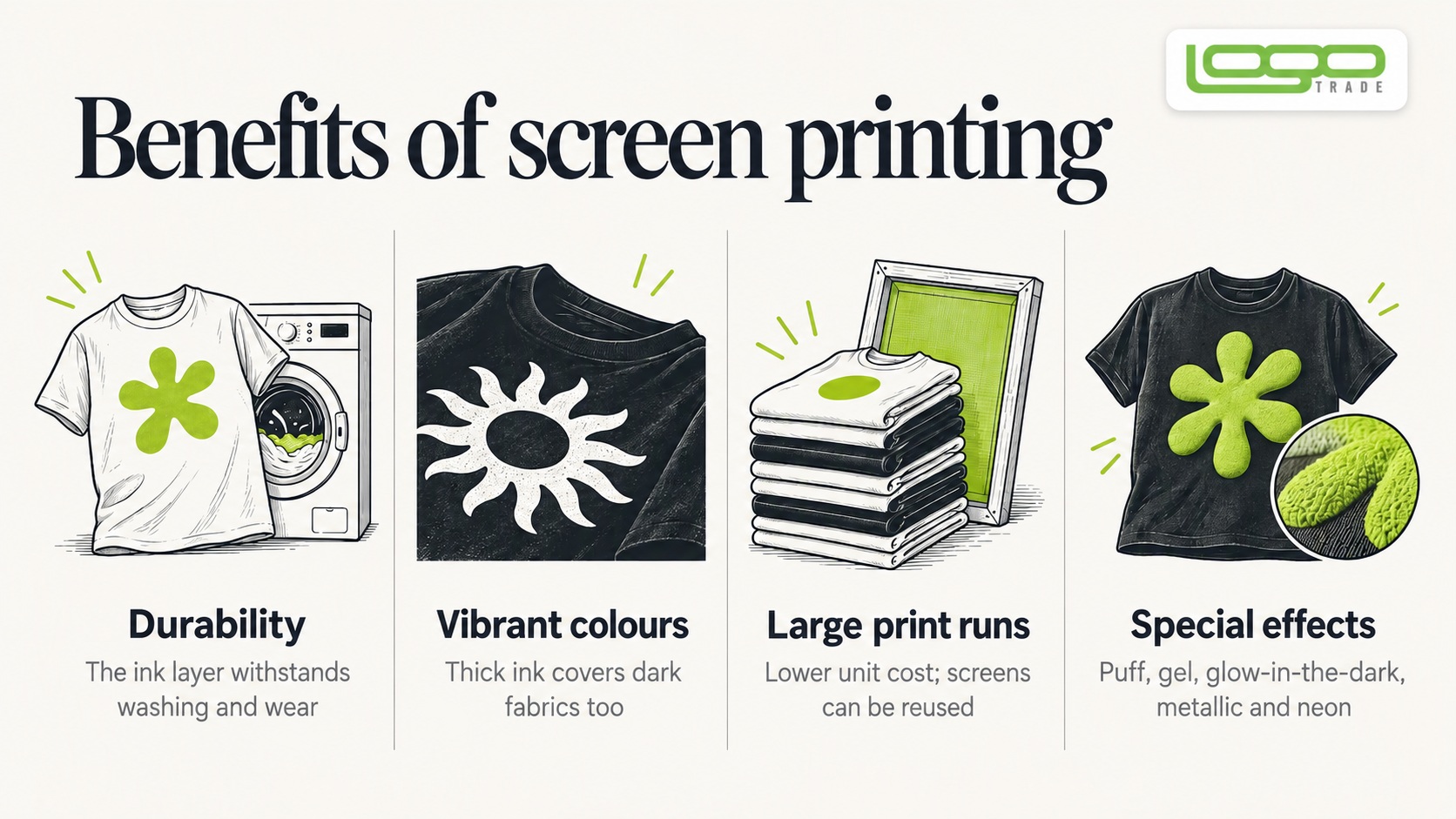
Screen printing has remained the mainstay of textile printing for decades, and the reasons are simple. Three main advantages are commonly cited: durability, vivid colors, and cost-effectiveness for large runs .
Durability. The ink layer penetrates the fiber and, when fixed with heat, withstands washing and wearing well. This is crucial for work clothes that are washed every week.
Bright and opaque colors. The screen printing ink is thick and gives a saturated and accurate result even on dark fabrics. A white logo on a black sweatshirt looks just as white as it should.
Low price for large quantities. Once the frames are made, each subsequent product adds almost no preparation cost. The larger the print run, the lower the price per print.
Repeat orders are easy. Screens can be saved and reused , which reduces costs and shortens delivery times when shirts with the same logo need to be reordered every year, for example for company summer events or for new employees.
Special effects. Screen printing can do things that digital printing can't: embossed puff printing, soft gel printing, glow-in-the-dark ink, metallic and neon tones. These are well suited for shirts for events, sports competitions and campaigns where the logo needs to stand out.
Limitations to know before ordering
Screen printing is not the right solution for every project. The main limitations are longer lead times due to initial setup, difficulties with gradients and complex color transitions, and the need for professional skills .
In practice, this means the following:
- A small quantity is not worth it. With ten shirts, the cost of frames and setup is spread over a few products, and the price of one print increases.
- Each color costs money. A six-color logo requires six frames. If the design can be simplified to two or three colors, the cost drops significantly.
- Photos and smooth transitions are difficult. They can be done with halftone dots, but the result will never be as smooth as in digital printing.
- Personalization is cumbersome. A different name or number on each shirt would mean a separate screen for each variant. This is often combined with a screen-printed logo and a DTF-printed name.
- Time. Making frames, mixing inks, and drying takes time. If you need the shirts the day after tomorrow, mention it right from the start.
What clothes and materials is screen printing suitable for?
Screen printing is suitable for almost all flat textiles that can withstand the heat required to fix the color. The most common ones are printed on:
- T-shirts and polo shirts
- sweatshirts, hoodies and sweatpants
- work clothes, vests and reflective vests
- cloth bags and shopping bags
- aprons, towels and other home textiles
The rule of thumb for materials is: the more natural fibers, the cleaner the result. According to one common textile ink instruction manual, the best results are achieved with 100% cotton fabric that is untreated and without fabric softener . This is why new clothes are washed before printing when self-printing. Industrial printing uses special inks for polyester, blended fabrics, and technical materials that prevent the fabric ink from bleeding through the print and cracking when stretched.
The shape and seams of the product are the limiting factors. It is difficult to place screen printing on a very narrow area, such as a sleeve edge, collar or pocket flap. For a cap, such as the Tase cap , embroidery or transfer printing is often better because the curved front panel does not lie flat on the printing table. For stretchy sportswear, care must be taken to ensure that the ink is elastic.
If you’re not sure how your logo will look on your chosen fabric, ask for a sample before committing to a large order. This is especially helpful if you’re printing a light color on a dark synthetic fabric, using a special effect, or ordering clothing from a new manufacturer whose fabric composition you haven’t tried before. A sample will cost less than an entire batch that doesn’t meet expectations, and it also gives your team a chance to hold the garment in their hands before making a decision.
If you choose a bag with a logo on it, you can find an overview of materials and bag types in our article on cloth bags with logos .
Screen printing or DTF printing: which one to choose?
The most common question we get asked is whether to screen print or DTF print. DTF (direct to film) means that the design is first digitally printed onto a special film, coated with adhesive powder and then transferred to the fabric using a heat press. There is no need for frames, so the preparation for one shirt is the same as for a hundred shirts.
The comparison helps you decide:
| Criterion | Screen printing | DTF printing | Embroidery |
|---|---|---|---|
| Suitable quantity | Medium and large print runs | Single items to medium print runs | Any quantity |
| Number of colours | A separate screen and extra cost for each colour | Colour count does not affect the price | Limited by available thread colours |
| Photos and gradients | Difficult | Reproduced accurately | Not suitable |
| Feel on the fabric | Ink bonds with the fibres; soft feel | A thin film on the fabric | Raised, premium finish |
| Durability | Very good | Good; depends on heat pressing | Very good |
| Personalisation (names, numbers) | Cumbersome | Easy | Possible, but time-consuming |
| Special effects | Puff, gel, glow-in-the-dark, metallic | Limited | 3D embroidery, appliqué |
| Suitable materials | Cotton, blends and polyester with suitable ink | A wide range of materials | Thicker fabrics, caps and fleece |
A simple rule of thumb: if the quantity is large and the logo has few colors, choose screen printing . If the quantity is small, the design is colorful, or each product is different, choose DTF printing. For formal branded clothing and hats, embroidery gives the most dignified result.
In many projects we use both. For example, shirts for a sporting event have the event logo screen-printed on the chest, which is the same on all 300 shirts, and the participant's name DTF-printed on the back.
Screen printing on non-textile promotional products
The principle of screen printing also works on hard surfaces: glass, ceramics, metal, plastic and paper. Flat surfaces, such as notebook covers, plastic boxes or labels, are printed with a flat frame. For cylindrical products, such as beverage bottles and glass jars, there are cylindrical screen-printing machines where the product rotates under a frame.
However, when it comes to promotional products, it's worth knowing that screen printing is not always the best choice:
- For small and curved products , such as pens, key chains, and USB sticks, pad printing is commonly used, which transfers the image to an uneven surface with a silicone pad.
- Metal beverage bottles and tools often benefit from laser engraving, which provides a durable mark.
- For multi-colored designs on hard surfaces, UV printing makes sense, as it prints in full color without frames.
When planning a screen print on a hard surface, consider the size of the print area, the curvature of the surface, and whether the product can withstand the heat required to dry the ink. For some products, the manufacturer limits the method and size of the area that can be used to apply the logo. That's why we always ask what product you have in mind before recommending a method.
Design file and print run: what the printing house asks of you
A good file saves time and money. A vector file (AI, EPS, SVG, or PDF saved as vectors) is best for screen printing, as each color can be extracted as a separate layer and the frame can be made in any size without loss of quality.
Before requesting a quote, please write down:
- Quantity and size distribution. For example, 120 shirts: 20 S, 40 M, 40 L, 20 XL. The size distribution also affects the ordering of the product.
- The product and its color. Printing on light fabric is easier, while dark fabric often requires a base layer of white, which adds one printing pass.
- Print locations and sizes. Chest, back, sleeve. Each print location is a separate print with its own frames.
- Number of colors and shades. If the brand book specifies Pantone codes, include them.
- Deadline. When the order must arrive, not when it should be ready.
If you only have your logo as an image file (JPG or PNG), don't worry: our designers can draw it as a vector and help you optimize the number of colors. Often, a little simplification is enough to print a six-color logo in three colors without anyone noticing the difference.
In terms of print run: screen printing becomes affordable where the preparation cost is spread over a sufficiently large number of products. The exact limit depends on the number of colors and print locations, which is why we always make an offer based on a specific design and, if necessary, we also calculate the DTF variant for you to compare.
Here's an example of how pricing logic works. Let's say a company orders 150 black T-shirts with a two-color logo on the chest for the summer. The black fabric adds a white base layer, so three frames are needed. They are made once and the setup cost is divided over 150 shirts, making it cheaper to print one shirt. If the same design were to be used on only twelve shirts, the setup cost would be the same, but it would be divided over twelve. In this case, DTF printing is almost always more reasonable. However, if the same logo is reordered next year, the frame design is already available and you can get started faster.
How to care for screen-printed clothes
A properly cured screen print lasts a long time when the clothing is cared for correctly. These tips will extend the life of your print:
- Turn the fabric inside out before washing so the print doesn't rub against the drum or other clothes.
- Use a lower wash temperature where possible and always follow the garment and print care instructions. For example, Marabu Textil Print hobby ink is fixed after drying by ironing without steam for 3 minutes or heating in an oven for 8 minutes at 150 °C; it can then be washed at up to 40 °C. These are instructions for that particular hobby ink, not a universal curing schedule for industrial inks: follow the ink manufacturer’s and garment care instructions.
- Do not use bleach or strong stain removers on the printed area.
- Air dry rather than tumble dry, the high heat of a tumble dryer will damage both the fabric and the print.
- Do not iron directly on the print. If ironing is necessary, turn the fabric inside out or place a protective cloth over the print.
These recommendations also apply to workwear that is washed frequently. If your team needs suitable clothing, check out our workwear range .
Our view: start with the use, not the method
We have been in the business of promotional gifts and corporate clothing since 2004, and the most common mistake we see is that the customer starts with the method. “I want screen printing” is a good start, but a better question is: who will wear this garment, how often will it be washed, how many pieces will be needed, and will there be a repeat order next year?
If the answer is “200 employees, washed every week and more every spring,” screen printing is almost always the right choice. If the answer is “15 shirts for conference speakers, each with their own name,” we recommend DTF printing. If the answer is “executive wear,” we’re talking embroidery.
Since we do DTF, silkscreen, DTG, pad and UV printing, laser engraving and embroidery ourselves, we don't have to impose any method. We can look at the project as a whole: choose the product, adjust the design, brand, pack and deliver the order to the place of delivery in Estonia or elsewhere in Europe. It is this project-based approach that prevents a situation where the entire batch is printed with a method that is not suitable for its use.
Order screen printing via Logo.ee
If you have a logo and know more or less the quantity, send us an inquiry. Logo.ee does screen printing on textiles and products and we also help with product selection, design, packaging and delivery. If you prefer to see which products look good with a logo first, browse our product categories or read ideas in the article corporate gifts with a logo .
Frequently asked questions
Can screen printing only be done on silk clothes?
No. The name comes from the fact that silk was originally used as the printing mesh. Today, the mesh is synthetic and can be printed on cotton, blended fabrics, polyester, and also hard materials.
How many shirts do you need to order for screen printing to pay for itself?
The exact limit depends on the number of colors and print locations, as each color needs its own frame. The fewer colors and the larger the quantity, the cheaper the screen printing. For small quantities, we also calculate the price of DTF printing separately so you can compare.
Does screen printing or DTF printing last longer in the wash?
Both are durable when heat-set correctly. In screen printing, the ink soaks into the fiber and holds up very well to frequent washing, while DTF printing is a thin film on the fabric and its durability depends largely on the quality of the pressing. Both will last longer if you wash them inside out and avoid tumble drying.
Can a photo be printed with screen printing?
Yes, but the photo must be divided into raster dots and the result will not be as smooth as digital printing. For photos and complex color transitions, we recommend DTF or DTG printing.
What file format should the logo be in?
A vector file is best: AI, EPS, SVG, or PDF with vectors. If you only have a JPG or PNG, our designers will convert it to vector.