


Branded homeware: choosing candles and placing orders
Home goods with a company logo are gifts that will last longer in the recipient's life than most promotional products: a blanket on the couch, a cutting board in the kitchen, a mug next to your morning coffee, a candle on a dark evening. If the gift is useful, the recipient never has to "use" it, they just use it. Here you will find out which home goods are suitable for customers, employees and partners, how to choose a candle as a corporate gift, which logo marking method is suitable for which material and how to plan a large order well in advance.
At a glance
- Choose a home item based on its use. A home item with a good logo is something that the recipient would use even if the logo wasn't on it: a blanket, mug, cutting board, or candle.
- When it comes to candles, the material, scent, burn time, and packaging are all important. A modest scent and clear manufacturer information are more suitable as a corporate gift than a strong, polarizing aroma.
- The marking method depends on the material. Engraving is suitable for wood and metal, UV or pad printing for ceramics and glass, and embroidery, DTF or screen printing for textiles.
- The logo must be clear at a small size. Fine lines and shadows will be lost on a small surface and a round object.
- Start planning early. Quantity, design, sample and delivery take time, especially before Christmas.
Table of contents
- Why home goods are suitable as corporate gifts
- Which homeware can you put a logo on?
- Candles for corporate gifts
- How to apply a logo to each material
- Home goods for different recipients and occasions
- Planning a larger order
- Choosing durable products and substantiating environmental claims
- Our view
- Branded homeware from LogoTrade
- Frequently asked questions
- Sources
Why home goods are suitable as corporate gifts
The value of a promotional gift depends on how often it catches the recipient's eye. A pen disappears into a drawer, but an item used at home is part of the daily routine. A coffee mug is in hand every morning, a throw is on the couch all winter, and a cutting board is in the kitchen for years.
The second reason is emotional. Home goods tell the recipient that you were thinking about their free time, not just their work. This is why home goods are great for year-end gifts, employee thank-you gifts, and long-term partners who find a simple logo gift too simple.
The third reason is practical: home goods usually have more surface area and more material options than small souvenirs. This gives space for design. A logo can be engraved into the corner of a wooden cutting board, embroidered on the edge of a throw, or printed on the side of a mug so that it is visible but not dominant.
If you want a broader overview of how to choose a memorable and useful souvenir, read our guide on how to choose a memorable promotional gift .
Which homeware can you put a logo on?
The table below will help you match product type, decoration method, and recipient. This is a starting point, not a definitive list: we will compile the exact selection and availability based on your request.
| Household goods | Suitable marking method | Who is suitable for? | When to give it |
|---|---|---|---|
| Mug, thermos, glass | UV printing, pad printing, laser engraving (metal) | Customers, employees, event guests | Year-round, trade shows, new employee package |
| Throw, blanket, towel | Embroidery, DTF printing | Employees, long-term partners | Christmas, winter campaign |
| Cutting board, serving tray | Laser engraving | Partners, management gift | Year-end, anniversary, contract signing |
| Candle, candle holder | UV printing on label or packaging, engraving on base | Customers, employees, guests | Dark months, Christmas, Advent |
| Apron, kitchen towel | Embroidery, silkscreen printing, DTF printing | Food and hospitality customers | Cooking events, summer campaigns |
| Gift set | Combined marking | Key customers, employees | End of year, thank you event |
Home goods work best with other products. A mug, chocolate, and candle in one box is a complete gift; a set of four logo products, however, feels like a well-thought-out brand experience. For ideas on the sweet part of the set, see the article Logo-branded candies that make your brand memorable .
Candles for corporate gifts
In Estonia, a candle is a welcome gift in the darker months. It feels personal and suits clients and colleagues alike. Consider four things when choosing a candle.
Material and composition
When choosing a candle, look at what the wax and wick are made of and whether the manufacturer has clearly stated the ingredients. High-quality ingredients and properly labeled manufacturer information are important for a gift, because the recipient will burn the candle in their home and expect it to burn evenly, not soot or produce an unpleasant odor. If environmental issues are important to the company, ask for precise information about the origin of the material and packaging, and do not make more claims in the gift than the manufacturer can prove.
Fragrance and intensity
When it comes to corporate gifts, you don't know the recipient's taste. Therefore, a safer choice is an unscented candle or a light, neutral scent: wood, linen, pure cotton, vanilla, or light citrus. A strong, sweet, or spicy scent may be very appealing to one person and a headache to another. If you're giving to a larger group, consider two options, unscented and lightly scented, and let the recipient choose.
Burning time and size
The burning time stated by the manufacturer is an estimate. After cooling and cleaning, the empty container can be used, for example, as a pencil cup, if the manufacturer's instructions allow it. For food or drink, use only the container intended for this purpose.
Design and logo placement
For candles, the logo is usually not applied to the wax, but to the container, label, lid or packaging. The logo can be engraved or printed on glass and metal containers, printed on the label and box. A good rule of thumb is to keep the logo small and clean so that the candle remains a decorative item that the recipient wants to display, not hide in a cupboard.
Safe use
Choose a candle that has the manufacturer's safety instructions, and keep them legible even after labeling with the logo. Burn the candle on a stable, heat-resistant base, away from curtains and other flammable objects, and out of reach of children and pets. Do not leave a burning candle unattended.
How to apply a logo to each material
The materials used in household goods are very diverse: ceramics, glass, wood, metal, textiles, cork. Each of them requires its own way of marking. The choice affects both appearance, durability and price.
| Material | Suggested method | Result |
|---|---|---|
| Wood, bamboo, cork | Laser engraving | Natural tone and material-dependent durability |
| Stainless steel, aluminum | Laser engraving | A single-color mark whose hue and durability depend on the surface |
| Ceramics, glass | UV printing, pad printing | Colorful logo, precise detail |
| Plastic and small items | Pad printing, UV printing | Suitability depends on the shape, size and material of the surface |
| Throws, towels, aprons | Embroidery | High-quality and long-lasting appearance |
| Cotton textiles, bags | Screen printing, DTF printing, DTG digital printing | Screen printing for large quantities, DTF and DTG for multi-color designs |
The design of the logo itself is as important as the way it is marked. The logo must be clear and legible : complex shadows and very fine lettering can create limitations in use. This is especially noticeable on home goods, as the convex surface of the mug, the thickness of the embroidery thread and the depth of the engraving simplify every detail. If a company needs a logo that will also work in small sizes and in one color, a hand-drawn logo design helps to think through how the mark will behave on a small and uneven surface.
Practical tip: ask for a single-color version of the design and view it at about 3 cm wide. This will help you assess legibility. For engraving and embroidery, check the actual marking area and ask for a sample if necessary. For a more detailed comparison of methods, see our logo application methods guide , and for design tips, see our article on how to design logo merchandise that works .
Home goods for different recipients and occasions
The same product is not suitable for every recipient. Before choosing, think about who the gift is going to and what it should say.
Key customers and partners. Quality and material count here. An engraved wooden cutting board, a steel thermos or a thoughtful gift set shows that the relationship is important to you. The logo can be modest, because the gift speaks for itself.
Employees. It's good to give employees something that will make their home more comfortable: a blanket, a mug, a candle, or a set that combines them. The gift can be more personal and the design bolder, for example with a team slogan or the year. If you're also giving employees clothes, see the article Promotional textiles that people actually wear .
Event guests and trade show visitors. For large quantities, a light, compact, and easily transportable home item is preferred: a mug, tea towel, or small candle. Also consider how the guest will take the gift home: the bag or packaging is part of the experience.
Welcome pack for a new employee. A mug, thermos and notebook are a classic trio, to which you can also add a home product. A ready-made solution is, for example, Tactical notebook gift set , next to which you can put a mug with a logo.
End of the year and Christmas. December is the peak season for home goods: throws, candles and sets are best suited for the dark time. In Estonia, the taxation of a gift depends, among other things, on who it is given to; we have written a separate guide on the taxation of corporate gifts in Estonia .
Planning a larger order
A larger order for branded homeware takes planning. The more items and product types you order, the more the sequence matters.
- Determine the purpose and recipients. Who the gift is going to, how many people, will everyone get the same thing or will there be multiple levels (for example, key customers and the rest).
- Set a budget per recipient. Consider the cost of the product, branding, packaging, and shipping together, not just the price of the product.
- Choose products and materials. Based on what the recipient uses, check that the material is compatible with the desired decoration method.
- Prepare your logo files. A vector file (AI, EPS, PDF or SVG) and a monochrome version will save you time. If you don't have a file, we can help with the design.
- Confirm the mockup. Before production, you can see where the logo will be located and what size it will be. Review it with a colleague who is responsible for the brand.
- Ask for a sample if necessary. For a new product or a complex design, a sample helps make sure the color and layout are exactly as you want.
- Arrange for packaging and delivery. Will the gifts come to one location, multiple offices, or directly to the recipients? Will each set come with a card or tag?
- Leave some time. Production and shipping are busy in the run-up to Christmas. The earlier you send your inquiry, the more choices you will have and the smoother the process will be.
We will tell you the exact production and delivery time based on your request, as it depends on the product, quantity, and decoration method.
Choosing durable products and substantiating environmental claims
Choose a long-lasting item that the recipient is likely to use. Wood, bamboo, cork, glass, and organic cotton are possible materials. The name of the material alone does not indicate the environmental impact of the product.
For wood products, check the FSC label for the specific product and ask the supplier for documentation. An example of a wood product supplier is Faster Displays . For textiles, ask about the fiber and dyeing.
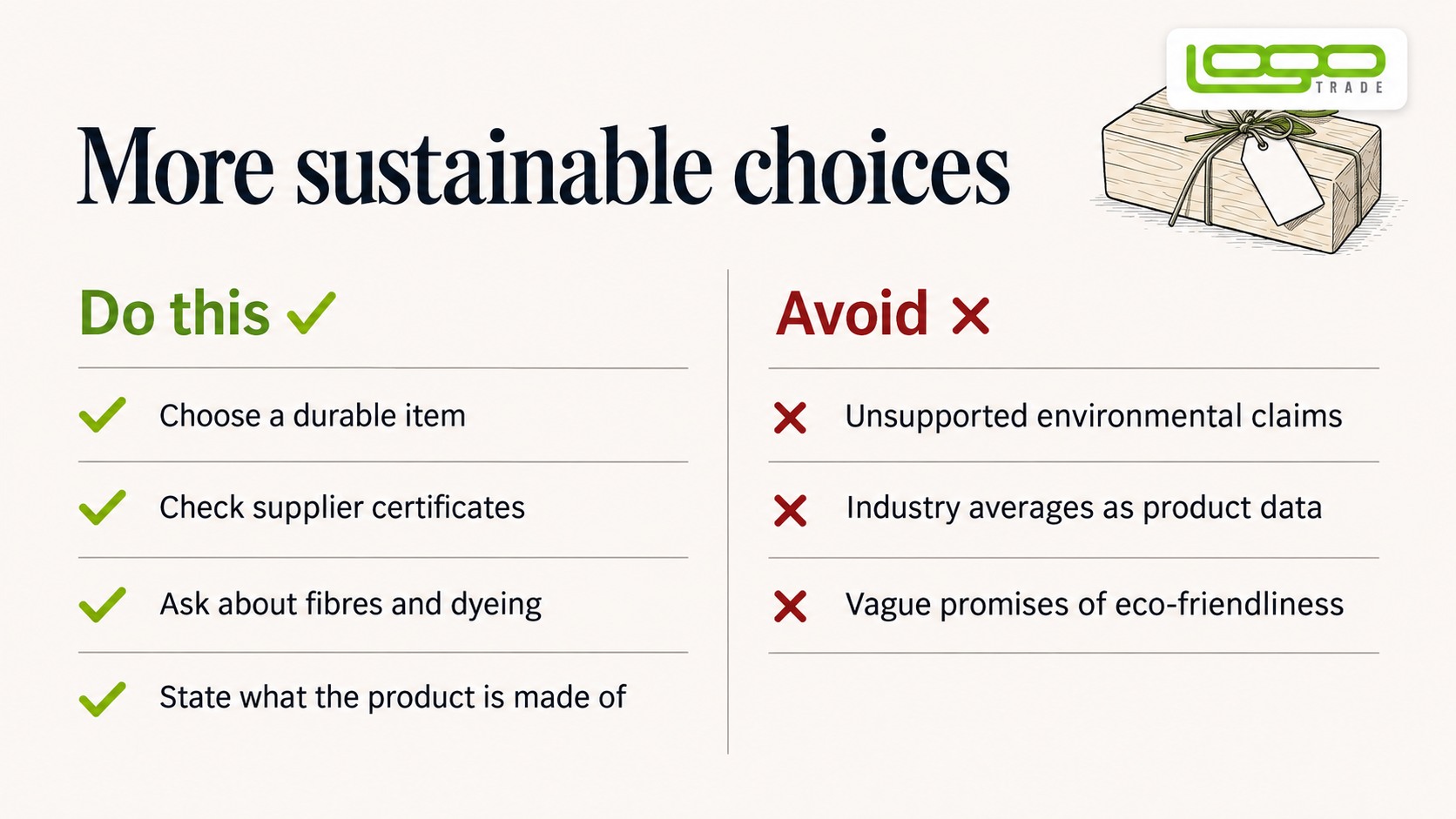
If you write an environmental claim on a gift card or in a campaign, it must be verifiable. The joint textile guidelines of the Dutch and Norwegian consumer protection authorities emphasize that environmental claims must be substantiated and must not be misleading , and that a general average must not be presented as data for a specific product. It is safer to write exactly what the product is made of than to promise a general “environmental friendliness”.
Our view
We have been dealing with promotional gifts since 2004 and we see the same pattern every year: gifts that go to the recipient's home receive the most feedback. A mug, a blanket or a candle is not just a logo carrier, but an object with which a person spends their free time.
That's why we never start with a product catalog, but with the question of who the gift is going to and what it should say. Based on this, we recommend the product, material and decoration method. Engraving on wood, embroidery on a throw, UV printing on a mug: each choice must match both the material and the brand.
Logo size and placement, packaging and the gift card all affect how the gift feels. We can handle product selection, artwork, branding, packaging and delivery in Estonia and across Europe, while you decide who receives it.
Branded homeware from LogoTrade
At Logo.ee, choose homeware, drinkware, textiles and gift sets. Depending on the product, we can apply your logo by laser engraving, UV printing, pad printing, screen printing, DTF, DTG or embroidery. We help with product selection and artwork, pack the order and deliver it in Estonia or across Europe.
Browse our product range by category or explore our logo branding services and send us an inquiry. We will put together a proposal based on your budget and recipients.
Frequently asked questions
Which home goods are best suited as a customer gift?
Items that are used every day work best: mugs, thermoses, blankets, cutting boards, and candles. For a key customer, a high-quality material and a modest logo, such as engraved wood or steel, are suitable. For a larger number of customers, a compact and easily transportable product is a good choice.
Is a candle a suitable corporate gift?
Yes, especially during the dark hours and at the end of the year. Choose an unscented or lightly scented candle, with the composition and burning time indicated by the manufacturer. Put your logo on the container, label or packaging and include a short safety instruction with the gift.
What logo marking should be used on wood and glass?
Laser engraving can be suitable for wood, bamboo and metal. The result depends on the material, coating, process and use. UV or pad printing can be suitable for glass or ceramics. Only mark the rim of a beverage container or a surface that comes into contact with food if this is approved by the manufacturer of the product and marking system.
What file should the logo be in for an order?
Send a vector file in AI, EPS, PDF or SVG format, along with a one-colour version. A vector logo scales without losing quality. We can help with the artwork if you do not have a vector file.
How early should you order Christmas gifts?
Start early. Production and shipping are especially busy in December. Allow time for choosing products, approving artwork, reviewing a sample if needed, production and delivery. Ask us for a schedule for your order.
Sources
- Creating a logo for a business that serves a purpose
- Faster Displays
- NCA and ACM joint guidance document to the Sustainable Apparel Coalition