


Workwear with your logo: choosing, branding and ordering
Good workwear with a logo comes out when the garment, marking and sizes are matched from the start. The logo must match the fabric, the fabric must match the work and the sizes must match the people. The safest way is to order everything from one place: from a partner who helps you choose a model, designs the logo, chooses the marking technique, marks the clothing and delivers the order. Logo.ee does all this as one project and has been dealing with promotional products since 2004. Below we will go through all the decisions that come up when ordering workwear: which garment for which job, when to choose embroidery and when to print, how to get the sizes right and what the law says.
In short
- Clothing is chosen according to the job. Layered clothing is suitable for field work, a polo or shirt for the office and customer service, and a durable sweatshirt or jacket for the warehouse and production.
- The marking is chosen according to the fabric and use. Embroidery is suitable for strong and frequently washed garments, screen printing for large quantities of single colors, DTF and DTG for multi-color designs.
- Sizes are collected before ordering. A size chart for employees and a few spare clothes prevent reordering.
- Law and taxes. If the nature of the work requires it, the employer provides work clothes at its own expense and this is a business-related expense.
- One partner for the entire process keeps the logo consistent and the schedule under control.
Table of contents
- Where logo workwear pays off
- Material and cut according to the nature of the work
- Embroidery or print: how to choose a marking
- Sizes and quantity: how to order correctly
- Ordering step by step
- Taxes and expenses: what the employer needs to know
- Maintenance: to make the garment and logo last
- Workwear with logo from Logo.ee
- Our view: workwear is the everyday representative of the brand
- Frequently asked questions
- Sources
Where logo workwear pays off
Workwear does two jobs at once. First, it protects and clothes the employee. Second, it shows the customer who they are. When an installer knocks on a customer's door in a company jacket, a store employee wears a logo polo shirt, or a warehouse worker walks around in a uniform sweater, the company is recognizable even before the first word is spoken.
Occupations where the employee is in front of the customer benefit the most from this:
- Installation, construction and maintenance. The employee visits the customer at home or on site, and the logo on the clothing creates trust.
- Trade and customer service. Uniform clothing helps shoppers find service personnel and makes the sales floor more orderly.
- Catering and accommodation. An apron, shirt or polo with a logo connects the service to the brand.
- Logistics and courier service. Company clothing is a moving advertisement at every address to which the package is delivered.
- Events and trade fairs. The team in uniform shirts is immediately noticeable in the booth.
In Estonia, the employer must provide the necessary work clothing and personal protective equipment at his own expense, depending on the nature of the work. This is required by Section 13(1)(11) of the Occupational Health and Safety Act. The price of logo marking depends on the selected clothing and equipment.
Trust and recognition are the same reasons why products with a logo are ordered in the first place. Read more about them in the article Benefits of products with a logo for a brand. Workwear is particularly useful among them because it is worn every day.
Material and cut according to the nature of the work
Good workwear won't interfere. If the garment is too warm, too thin or too tight, it will stay in the closet and the logo with it. Therefore, start by asking where and how the garment will be worn, and only then choose the model.
When working outdoors in the Estonian climate, layered clothing is practical: a base layer, an insulating layer (such as a fleece or wool sweater), and a weatherproof top layer. The logo can be placed on any layer, but it is most visible on the top jacket and fleece.
| Work setting | Suitable garments | What to check | Branding options |
|---|---|---|---|
| Office and customer service | polo, shirt, T-shirt | regular cut, breathable fabric | embroidery on the chest, fine print |
| Store and showroom | polo, T-shirt, vest, apron | freedom of movement, frequent washing | embroidery or screen printing |
| Warehouse and production | sweatshirt, jacket, work pants | strong fabric, pockets | embroidery, screen printing on the back |
| Outdoor work and construction | Fleece, softshell or winter jacket | Layers and model-specific weather protection | Chest embroidery or a large back print |
| Catering | Shirt, apron or cap | Workplace hygiene and laundering requirements | Embroidery |
| Events and fairs | T-shirt, sweatshirt, hat | uniform color, fast delivery | screen printing, DTF |
When choosing a fabric, consider the frequency of washing, temperature and washing method. The durability of the label depends on the garment and the technique used. If the risk assessment requires personal protective equipment, such as high-visibility clothing, check the model compliance and follow the manufacturer's branding instructions. The logo must not reduce the required visible area or compromise the protective properties.
It's also worth remembering the other side: people are more likely to wear what's comfortable and looks good. We've documented this experience in the article Advertising Textiles That People Actually Wear.
Embroidery or print: how to choose a marking
The most confusing part of choosing a label is when it comes to choosing the right technique, as each technique is suitable for something different. The right choice depends on four things: the fabric, the number of colors in the logo, the quantity, and how often the garment will be washed.
| Method | How it works | Best suited to | Strengths |
|---|---|---|---|
| Embroidery | the logo is sewn into the fabric with thread | polos, jackets, fleeces, hats, sweatshirts | durable on suitable fabric, representative result |
| Screen printing | ink is applied to the fabric through a stencil | large quantities, 1–3 color logo | uniform and strong, advantageous for large quantities |
| DTF printing | the design is printed on film and pressed onto the fabric | multi-colored logos, suitable mixed fabrics, smaller quantities | details and transitions remain accurate |
| DTG digital printing | print directly onto fabric like with a printer | cotton T-shirts, photos and intricate designs | suitable for details and color transitions |
Embroidery is often suitable for strong and sufficiently stable fabrics. The suitability depends on the polo, fleece, softshell or headgear and its marking area. Fine lettering and color transitions may require simplification of the design. The instructions explain the work process. Embroidery is often the best choice for workwear. The thread is stuck to the fabric and does not crack or peel, and the embroidery often lasts the entire life of the garment. It is best suited for strong fabrics: polos, fleece, softshell jackets and hats. Very fine lettering or shades cannot be accurately embroidered with embroidery, therefore the logo is simplified before embroidery if necessary. We have written step by step how it works in the article Embroidering a logo on clothes.
Screen printing is often suitable for large quantities when the logo has few colors, such as on the back of team sweatshirts. The durability of the print depends on the fabric, ink, mounting and care.
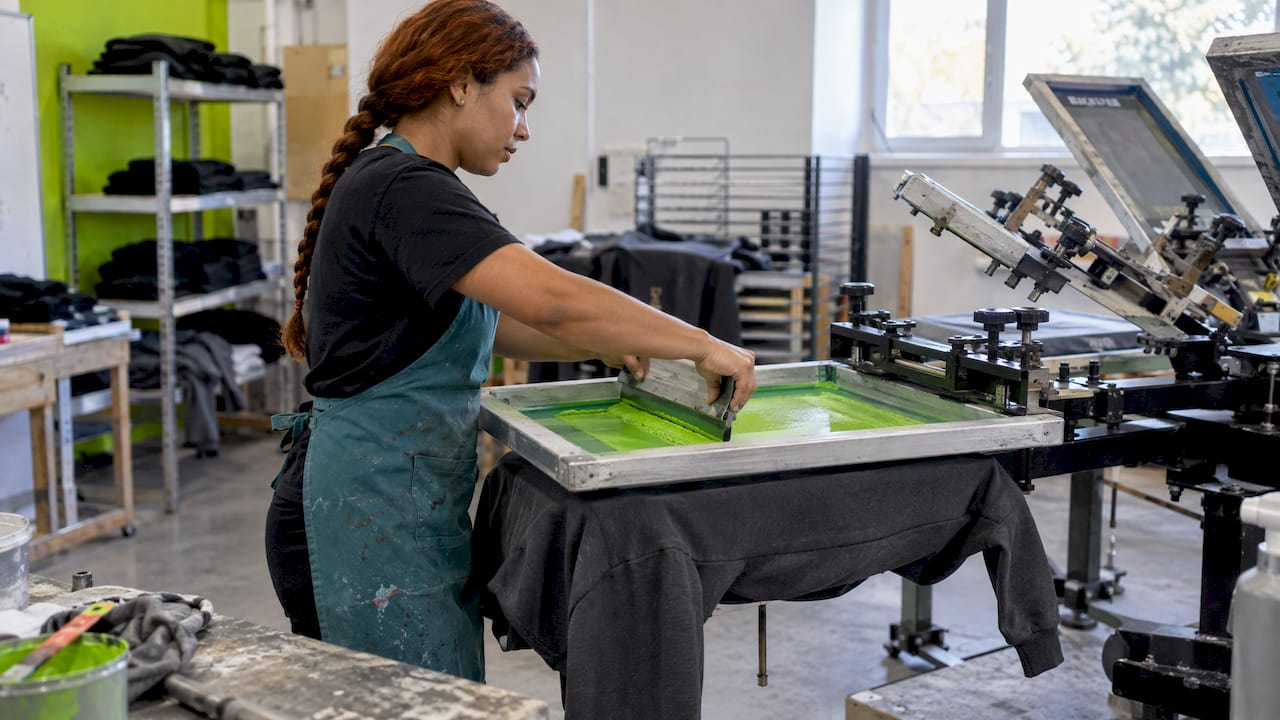
DTF printing is suitable for multi-color logos if the fabric and its coating are compatible with the transfer material and heat used. DTG is often suitable for cotton shirts for complex designs or smaller quantities. Confirm suitability with a specific model and a proof print if necessary.
Often the best solution is to use two techniques together: a small embroidered logo on the chest and a large print on the back. This way, the garment is presentable from close up and easily readable from a distance. Logo.ee does all of these techniques, so you don't have to go to different workshops for them and the logo remains the same on the clothing. You can also find the background of embroidery in our guide Embroidering logos on clothing.
Sizes and quantity: how to order correctly
When ordering workwear, the most common mistake is with the size. If the garment doesn't fit, the employee won't wear it, and ordering individual replacement garments later becomes more expensive than the original order.
This is how you get the sizes right:
- Make a table. Each employee's name, garment type, and size. If the same model is available in both men's and women's cuts, ask for both.
- Try it on first. Manufacturers vary in size. If possible, have a couple of employees try on the model before ordering a large quantity.
- Consider layers. Try on a winter jacket with fleece or other layers and choose a size based on the model's size chart and room to move.
- Order stock. In addition to the quantity you have counted, order a few garments in the most common sizes for new employees and replacements.
- Keep the table. For the next order, just update it with new people.
The quantity depends on the use and washing schedule. For daily wear, two or three sets may be sufficient to have a clean garment. The minimum quantity and unit price for the label depend on the garment and technique. The exact conditions will be confirmed in the offer.
Ordering step by step
Here's the order process from start to finish, along with the places where things most often go wrong.
- Explain the need. Who will wear the clothes, what job, what season, and how many people there are. Without this, the offer cannot be accurate. A Logo.ee consultant will help put this together during the conversation and recommend suitable models.
- Choose clothes. Model, material, color. A common mistake: choosing by looking at the picture, without thinking about the fabric and washing. Our consultant will look at the work and conditions of use and offer clothes that fit.
- Prepare the logo. A vector file (AI, EPS, SVG or vector PDF) is best, so the logo will look sharp at any size. If you only have a low-resolution image, don't worry: Logo.ee will do the design work itself and prepare the logo for branding. We describe the principles in the article design services for companies.
- Decide on placement and technique. The logo can be on the chest, sleeve, back or collar. Check that pockets, seams and protective features do not obstruct the marking area.
- Confirm the design. Review the size, colors, and placement of the logo on each garment. Also double-check the size chart.
- Production and branding. Logo.ee handles printing, embroidery or engraving, with one point of contact for the whole order.
- Packaging and delivery. The order will be packed and delivered in Estonia or elsewhere in Europe. If you have multiple offices, think ahead about where each quantity will go.
It's a good idea to plan your schedule backwards from the deadline, whether it's the start of a season, the arrival of new employees, or an event. Allow time to approve the design and gather sizes, as these are the stages that most often drag on.
Taxes and expenses: what the employer needs to know
In Estonia, work clothing necessary for and used for the performance of work duties is a business-related expense. The Estonian Tax and Customs Board's work clothing guidelines explain that the proportion of work and private use must be distinguished. If the employer bears the cost of the employee's private use, this part is generally a fringe benefit. If the employee pays the part of the private use themselves, there is no tax liability on this part.
The logo helps to identify the workwear. The tax treatment depends on the purpose and use of the clothing. It is worth discussing the taxation of casual clothing given to an employee with an accountant.
Clothing with a logo is part of a company's visibility and works best in conjunction with other marketing. If the clothing is noticeable on the street, it pays to carry the same visual identity online, where the company's digital marketing brings the brand to the same people on screen.
Maintenance: to make the garment and logo last
The frequency of cleaning depends on use, soiling, workplace hygiene requirements and manufacturer's instructions. General recommendations can be found in the Workwear Care Guide. For protective clothing, follow the manufacturer's care instructions.
For the logo, do this:
- Turn the garment inside out before washing. This will reduce the friction of the print and embroidery.
- Follow the garment and print or embroidery supplier’s care instructions. Where they differ, follow the stricter instructions.
- Do not iron directly onto the print. Iron from the wrong side or through the fabric.
- Avoid strong bleaching agents. They can fade both the fabric and the logo colors.
- Give the employee several sets of clothes. If there are several, each one will wear out more slowly.
If the garments are washed industrially, specify the washing mode before ordering and confirm that both the garment and the label can withstand it.
Workwear with logo from Logo.ee
Logo.ee offers workwear and textile products that can be branded with embroidery, screen printing, DTF printing or DTG digital printing. We help you choose the clothing, prepare the logo, label, pack and deliver the order in Estonia and across Europe. The entire process is in one place, so you have one contact and one person in charge.
View our workwear selection or learn about our branding services and request a quote.
Our view: workwear is the everyday representative of the brand
We have been dealing with promotional products since 2004, and workwear is a special case in this regard. A mug sits on a table and a pen in a drawer, but workwear travels with people every day to customers, to objects, and to the street. That is why it must be well thought out.
A good result is achieved when the garment, design and branding are one project. If the garments are ordered from one place, the logo is printed in another and the embroidery is done in a third, the colors, sizes and placement can easily be different. We carry out the entire process ourselves, from which garment to choose, to packaging and delivery.
We recommend starting with the work, not the catalog. Tell us who will wear the clothes and in what conditions, and we will provide a model and branding technique that suits it. That way, the garment will actually get worn and the logo will be visible for the entire life of the garment.
Frequently asked questions
Is embroidery or print better for work clothes?
Embroidery is often suitable for strong and stable fabrics. Print is suitable for large back designs and multi-colored logos. Sometimes it is worth combining chest embroidery and back print. The choice depends on the model, logo details and care.
What format should the logo be?
A vector file, such as AI, EPS, SVG or vector PDF, is best because it will keep the logo sharp at any size. If you don't have a vector file, Logo.ee will prepare the logo for branding as part of its design service.
Does the employer have to pay for the work clothes themselves?
If the nature of the work in Estonia requires it, the employer will provide work clothes at its own expense. Clothing required for work is a business-related expense. If the clothing is also used privately, the portion of the private use paid for by the employer may be a fringe benefit.
How do I know what sizes to order?
Before ordering, collect the sizes from all employees in a spreadsheet and, if possible, have a few people try the model on. Keep in mind that the winter jacket must fit over other layers, and order a few spare clothes in common sizes.
Can workwear with a logo be ordered for multiple locations?
Yes, Logo.ee will package the order and arrange delivery both in Estonia and across Europe. When requesting a quote, tell us where and what quantity you need to deliver, and we will plan the delivery accordingly.
Sources
Tax and Customs Board: taxation of workwear Kodus.ee: the right clothing for every job Kliin: workwear maintenance Veko Media: digital marketing for companies
Recommendations
- Corporate textiles: high-quality and durable clothing with a logo
- Clothing with a logo unites the team and increases motivation
- Logo embroidery on clothing – polo shirts, jackets, hats
- Embroidering a logo on clothes: durable corporate embroidery step by step