


Choosing workwear for your company: from job role to logo
When choosing workwear for your company, first answer the question of what the job requires. Then choose the material and fit, collect employees’ sizes, plan the sets and decide on the method of applying the logo to the garment. In the office and customer service, the main thing is presentability and comfort, in the warehouse and construction, safety and durability. The logo must survive washing and must not interfere with the protective properties. Below, this process is written down step by step so that the HR or marketing manager can complete the entire order based on it.
In short
- Start with a risk assessment. In a hazardous work environment, protective clothing is selected based on a risk assessment of the work environment , not on appearance.
- The employer pays. If the nature of the work requires it, the employer in Estonia provides work clothing and personal protective equipment at their own expense .
- Divide clothing into groups. Corporate clothing, everyday workwear, and certified protective clothing require different materials and different branding.
- Choose your logo based on the fabric. Embroidery is suitable for polo shirts, jackets and hats, the printing method (DTF, screen printing, DTG) depends on the fabric, quantity and number of colors.
- Collect sizes before ordering and order in sets, then each employee's clothing will arrive at the same time.
Table of contents
- Start with the work, not the clothes
- When is protective clothing mandatory?
- Material, fit and season
- Size collection and quantity planning
- Logo application of workwear
- Maintenance of workwear with logo
- Our view
- Branded workwear from a single supplier
- FAQ
- Sources
Start with the work, not the clothes
The most common mistake is to start with a catalog. A beautiful softshell jacket may be perfect for an office worker, but too hot for a warehouse worker and downright dangerous for an electrician. That's why, before choosing a product, write down all the positions and answer three questions for each position:
- Where does the employee work? Indoors, outdoors, near traffic, in a cold, wet or dusty environment.
- What does the employee do? Meets with clients, lifts and carries, works with machines, drives, stands all day.
- What are the hazards associated with the work? Are there any risks of impact, fall, flame, chemical or traffic hazards?
If the answer to the third question is yes, workwear is no longer just a question of brand. According to the Labour Inspectorate's guidelines, personal protective equipment is selected based on a risk analysis of the work environment and is used as a last resort if the risk cannot be adequately avoided by technical or work organisation measures. If you already have a risk analysis, use it as a basis for planning your workwear. If you do not yet have a risk analysis, arrange for it to be compiled with the help of a competent work environment specialist before purchasing protective clothing; if necessary, use a competent external service.
Involve employees. Estonia’s Occupational Health and Safety Act also requires employees or their representatives to be involved in the selection of new work equipment. In practice, this means that trying a few sample products before placing a large order will give a better result than any product description. A person who wears a jacket for eight hours a day will immediately notice if the sleeve is too short or the pocket is in the wrong place.
Three groups of work clothes
Most companies' needs fall into three groups. Once these are in place, it is easier to choose both the product and the branding method.
| Group | To whom | What is important | Suitable logo application |
|---|---|---|---|
| Corporate clothing | Customer service, sales, reception, trade fair team | Uniform appearance, good fit, wrinkle-free fabric | Embroidery on polos and jackets, DTF or screen printing on T-shirts |
| Everyday workwear | Warehouse, logistics, maintenance, production, couriers | Durability, freedom of movement, frequent washing, pockets | Embroidery or DTF, silkscreen printing in large quantities |
| Protective clothing | Construction, road works, electrical works, hazardous environments | Certified protective properties, CE marking, correct class | Only according to manufacturer's instructions, without covering protected areas |
In the case of corporate clothing, workwear is part of the company's visual identity, so it must fit with the rest of the dress code. If the company has not yet agreed on what to wear for different roles, a company dress code guide for managers and HR staff will help establish these principles. There is another side to logo clothing: for many teams, uniform clothing is a sign of unity, which we have written about in more detail in the article Logo clothing and team spirit .
When is protective clothing mandatory?
Estonian law does not say what kind of jacket to wear for every profession, but it does establish principles and some specific requirements.
Employer responsibilities. According to Estonia’s Occupational Health and Safety Act, the employer must provide personal protective equipment, work clothes, and cleaning and washing supplies at its own expense, if the nature of the work requires it. There must be a changing room for employees wearing work clothes, and a clothes drying room and a heated shelter or equivalent facility for outdoor workers. Consider this in your budget: ordering work clothes does not end with the delivery of the clothes, they also need to be stored and dried somewhere.
Construction. According to the occupational health and safety requirements for construction work, a helmet is mandatory in areas where there is a risk of head injury, and protective footwear must generally be used. A safety vest or clothing must be worn in areas where traffic is involved, and a reflective strip must be worn in the dark. The construction site must also have a changing room with separate lockers or compartments for work and casual clothing.
High visibility clothing. High visibility protective clothing is divided into three classes in the EN ISO 20471 standard. Each class specifies how much fluorescent background material and reflective material the garment must have at least. The choice of the appropriate class should result from a workplace risk assessment.
CE marking and Estonian language marking. Personal protective equipment sold in the European Union must comply with Regulation (EU) 2016/425 and bear the CE marking. The required marking on protective clothing must be visible, legible and indelible. For use in Estonia, the required instructions and safety information must be in Estonian; the CE marking and the standards' symbols and pictograms themselves are not translatable text. Check this before ordering.
Special requirements for professions. Some fields also have their own specificities. Regarding electricians' workwear, the expert article Elektriala explains that the clothing must be based on a risk analysis, avoid conductive metal parts, cover the body sufficiently and be the right size. Clothing that is too loose can increase the risk of flame exposure, while clothing that is too tight restricts movement. The same logic applies more broadly: when it comes to protective clothing, the right size is a matter of safety, not just comfort.
Material, fit and season
Once the risks are clear, the material can be chosen. There is no single right answer here, but there are some principles that we repeat over and over again when advising on orders.
Material according to the job. Cotton is pleasant to the skin and breathable, making it suitable for T-shirts and indoor clothing. A cotton-polyester blend generally wrinkles less and dries faster; the tolerance for frequent washing depends on the specific fabric and care instructions, so assess its suitability for everyday workwear. For outdoor workers, wind and rain protection layers appropriate for the weather are suitable, such as a softshell or a padded jacket with suitable properties. Not all softshells are waterproof: check the specifications of the specific model. The material of the protective clothing is determined by the protective function, not taste.
Fit and cuts. Order models with both male and female cuts. A garment with the same cut rarely fits everyone well, and a poorly fitting garment is simply not worn. Also look at the length of the sleeve and back, especially for those who bend over or raise their arms above their head.
Layers and season. In the Estonian climate, it's worth thinking in layers: a T-shirt or polo, a sweater or fleece, and an outer jacket. This way, you can wear the same outfit year-round and only change the top layer. Add a hat and a warmer jacket for winter, a more breathable shirt for summer.
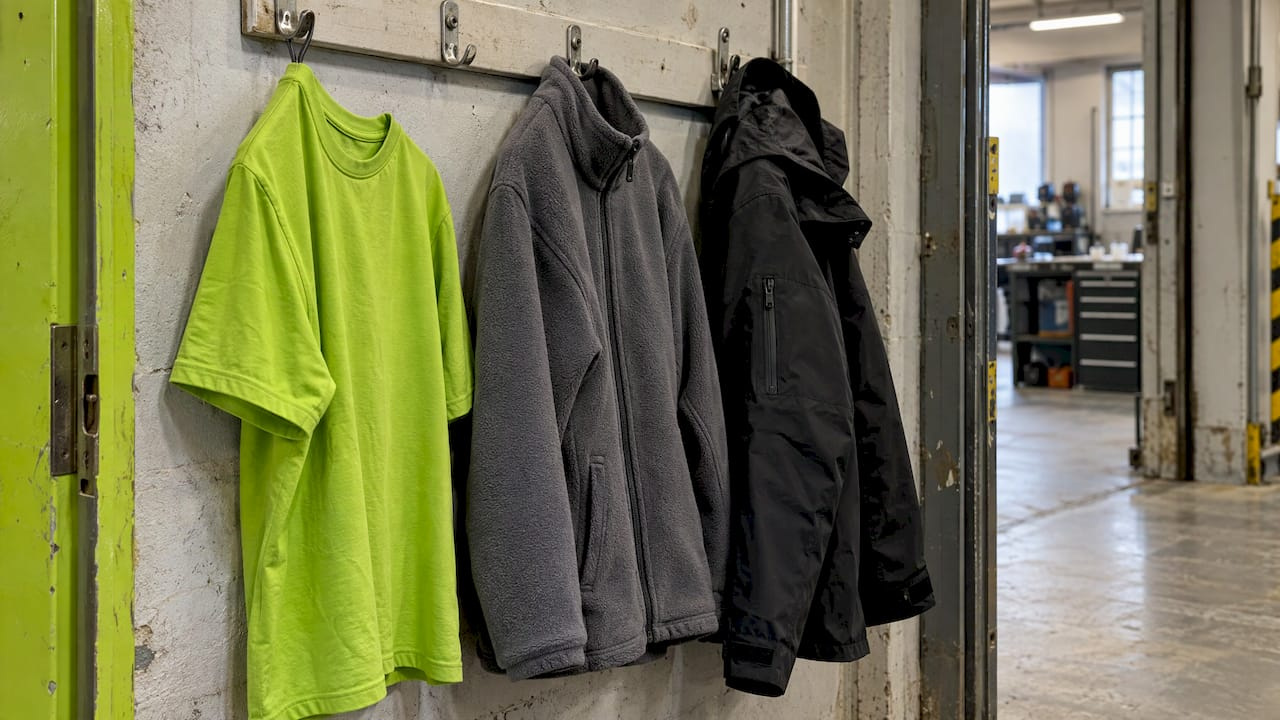
Care: Before ordering, ask what temperature the garment should be washed at and whether it can be tumble dried. If the company washes the workwear itself or orders a laundry service, both the fabric and the logo must be able to withstand this mode.
Consistent tone. If you order different products from different manufacturers, the “black” or “dark blue” may be slightly different on each product. If possible, choose products from the same product line or ask for a sample before placing a large order. We have written about which promotional textiles people actually like to wear in the article Promotional textiles that people wear .
Size collection and quantity planning
Sizing is where ordering workwear most often gets delayed. To avoid this, do the following:
- Create a sizing sheet. Record each employee’s name, job role, required garments, and the size and fit of every item. If a name is to be embroidered, record its exact spelling.
- Use the manufacturer’s size chart. Sizes vary between manufacturers. One brand’s M may differ from another’s, so share the chart for the actual garment.
- Arrange a fitting. If possible, order samples in several sizes so employees can try them on. This reduces exchanges later.
- Set a deadline. Give employees a clear date for submitting their sizes and appoint one person to collect the information.
- Allow for spares. Order a few extra garments in commonly used sizes for new employees and to replace worn items.
- Plan complete sets. Define a set for each job role, such as two T-shirts, a fleece and a jacket. Decide how many garments each person needs so there is always something to wear while another set is being washed.
A set-based order also helps later. When a new employee comes in, you immediately know what to order for them, and repeat orders go faster because the logo file, layout, and colors have already been agreed upon.
Logo application of workwear
The way you apply your logo depends on three things: the fabric, the quantity, and how much wear the garment will have. The table below shows how our methods typically break down in workwear.
| Method | Best suited | Strength | What to consider |
|---|---|---|---|
| Embroidery | Polos, jackets, fleeces, hats, work vests | Very durable, looks presentable | Very fine details and transitions need to be simplified |
| DTF printing | Cotton, polyester, blended fabrics, also smaller quantities | Multicolored, detailed, suitable for many fabrics | Large print area may appear stiffer on thin fabric |
| Silkscreen printing | Large quantities of T-shirts and sweatshirts | Good price in large quantities, bright colors | Each color requires separate preparation, suitable for logos with fewer colors |
| DTG digital printing | Cotton T-shirts, photo-like designs | Many colors and transitions, suitable for small quantities | Best result on cotton |
For more information on embroidery, see our logo embroidery guide and our logo application methods guide, which compares all methods. For workwear, we generally recommend embroidery wherever the garment needs to last for years and the fabric is thick enough: polo shirts, fleeces, jackets, and hats. If the logo is multi-colored or the garments are needed quickly and in smaller quantities, DTF printing is a flexible option.
Where to place the logo
The placement determines whether the logo is visible and whether the garment is comfortable to wear.
- The left side of the chest is a classic spot for polo shirts, shirts, and jackets. It's perfect for a smaller logo that's visible to the person you're talking to.
- The back is a place for a larger logo or company name when the employee often has their back to the public, such as couriers, installers, and event crews.
- The sleeve or shoulder is suitable for an additional element, such as a web address or department name.
- The hat provides visibility even when the jacket is closed or covered.
Avoid placing the logo on seams, zippers, pockets, and in areas where the garment is constantly rubbed, such as under backpack straps or over a seat belt. Also consider what is underneath the top layer: if an employee is wearing a jacket in the winter, no one will see the logo on the chest of a polo shirt, so the logo should also be on the jacket.
What to prepare for logo application
Branding will be faster if you send us your logo as a vector file, such as AI, EPS, SVG or PDF with vectors. Include your brand color codes and describe whether the logo is intended for light or dark fabrics, as dark clothing often requires a light or solid color version of the logo. For embroidery, we simplify very fine lines and small letters where necessary so that they remain legible with the thread. Before production, you will see a sample design, indicating the location and size of the logo on each product. For more design advice, see our article on promotional product design .
Logo on protective clothing
Adding a logo to certified protective clothing requires more attention. The class of high-visibility clothing depends on the surface area of the fluorescent and reflective material, so the logo must not cover the reflective strips or reduce the visible surface to such an extent that the garment loses its class. In the case of flame or heat protective clothing, the materials of the marking must also be compatible with the protective function of the garment. The safest way is to follow the clothing manufacturer's instructions on where and with what method the logo can be added, and discuss this before ordering.
Maintenance of workwear with logo
A well-chosen garment and well-made branding will last a long time if properly cared for.
- Follow the care label. Washing temperature, drying and ironing are written on the garment, and we also take the same care requirements into account when choosing the branding method.
- Wash inside out. This will help the printed logo to rub off less in the wash.
- Do not iron directly on the logo. For printed designs, iron inside out or through the fabric.
- Check protective clothing regularly. According to the Labour Inspectorate's guidelines, the employer must arrange for regular inspection and cleaning of personal protective equipment and repair or replace equipment that has become unusable. Follow the manufacturer's instructions for use.
If your company has a laundry service, let us know which washing programme is used before ordering. Then we can recommend a branding method that will withstand it.
Our view
We have been dealing with promotional products and logo clothing since 2004 and have seen that the best workwear order does not start with a catalog, but with the question of who will wear the clothes and where.
Workwear is a company's most visible advertisement. It's worn by the people who meet with customers every day, drive around town, and stand at trade shows on behalf of your company. If the garment fits well and the logo is still in place a year later, it will work for your brand every day. If it doesn't fit, it will stay in the closet.
That's why we always recommend a well-thought-out project: we map out the positions, select the right product for each role, create a design and choose a branding method that suits the specific fabric. Embroidery, DTF, screen printing and DTG are all good methods if they are suitable for the right garment. The most time and money is saved when the product, design, branding, packaging and delivery are in the hands of one partner.
Branded workwear from a single supplier
Logo.ee helps you choose your company's workwear and place the entire order in one place: we advise on product selection, create the design, apply the logo with embroidery, DTF, silkscreen or DTG printing, package and deliver the order both in Estonia and across Europe.
Browse our selection of workwear and promotional textiles , or check out our logo branding services and send us an inquiry. Tell us how many people and what positions need to be dressed, and we'll put together a suitable offer.
FAQ
Who pays for the employee's work clothes?
If the nature of the work requires work clothes or personal protective equipment, the employer in Estonia must provide them to the employee at the employer’s expense. The same applies to cleaning and washing supplies. In the case of corporate clothing, which is not required by law, the company decides for itself, but the employer usually pays for it as well.
Which logo application lasts the longest on workwear?
On thicker fabrics, such as polos, fleeces, jackets and hats, embroidery is often a durable and presentable choice. The suitability and durability of the method depends on the fabric, the execution and the care regimen. For T-shirts and mixed fabrics, DTF printing is a good choice, and for large quantities, screen printing is a good choice. The most important thing is to choose the method according to the specific fabric and washing regimen.
Can a logo be printed on a reflective vest?
Generally, the logo can be placed, but it must not cover the reflective strips or reduce the fluorescent surface to the point where the garment loses its visibility class. Follow the garment manufacturer's instructions and discuss placement before ordering. Often, the logo will fit between the reflective strips on the back or chest.
How much workwear should I order for one employee?
This depends on how often the clothes are washed and how quickly they wear out during work. For everyday clothes, consider that while one set is being washed, the employee will have another set to put on. Also add a spare for new employees and to replace worn-out clothes.
Sources
- Labour Inspectorate: Personal protective equipment – an investment in the future (2022)
- Official Gazette: Occupational Health and Safety Act
- Official Gazette: Occupational health and safety requirements in construction
- Elektriala: Expert explains how and why electrician's workwear must protect the wearer
Recommendations
- Logo Fleece Jacket: Best Corporate Wear 2026
- Logo application method guide
- Clothing with a logo unites the team and increases motivation
- Logo products that work: Effective promotional gifts